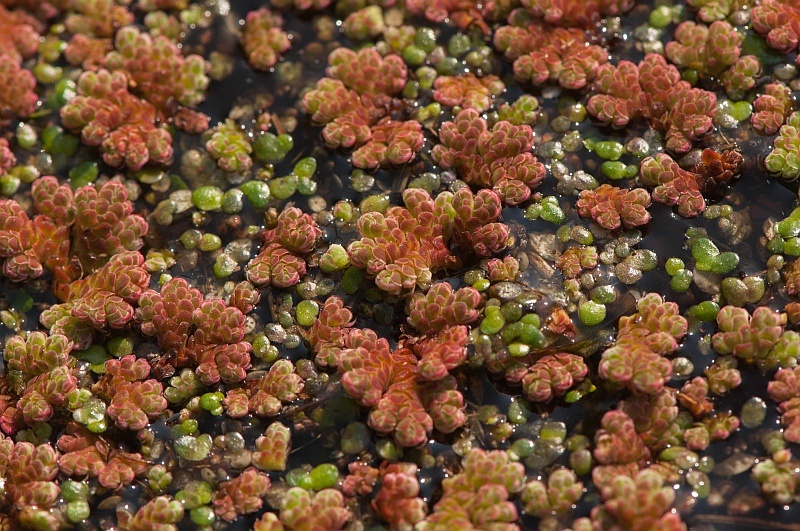
giant salvinia
Salvinia molesta D.Mitch.

Salvinia molesta, commonly known as giant salvinia, is a free-floating aquatic fern native to south-eastern Brazil. It has been introduced to numerous regions worldwide, including the United States, where it has caused ecological issues such as eutrophication. The plant is characterized by its fronds, which are 0.5–4 cm long and broad, with a bristly, waterproof surface formed by hair-like strands that join at the ends. Giant salvinia has a wide distribution, including locations in the Neotropical region, parts of Asia, Europe, and Africa.
Description
Giant salvinia (Salvinia molesta) is an aquatic fern in the family Salviniaceae. It is known for its rapid growth and invasive nature, particularly in freshwater ecosystems. The plant forms dense mats on the water surface, which can disrupt native aquatic life and water flow. It was first described in 1972 by D.Mitch. The species is native to south-eastern Brazil but has been introduced to many other regions, including the United States, where it has impacted lakes like Caddo Lake in Texas. Its fronds grow in pairs, with a third, root-like frond hanging beneath the water. The fronds have a distinctive bristly surface due to hair-like structures that join at the tips, creating a waterproof barrier.
Other common names
Kariba weedSalvinia mossgiant salviniakariba-weed
Distribution
Flores Island · Neotropical · TW · ZA · LK · NP · BR · Belgium · France · The Netherlands · Great Britain · BD · PK · PT · CO · BW · AT · NC · TH · KM · IL · FM · MU · SG · YT · Austria · Italy · ZW · SE · TZ
Synonyms
Salvinia adnata