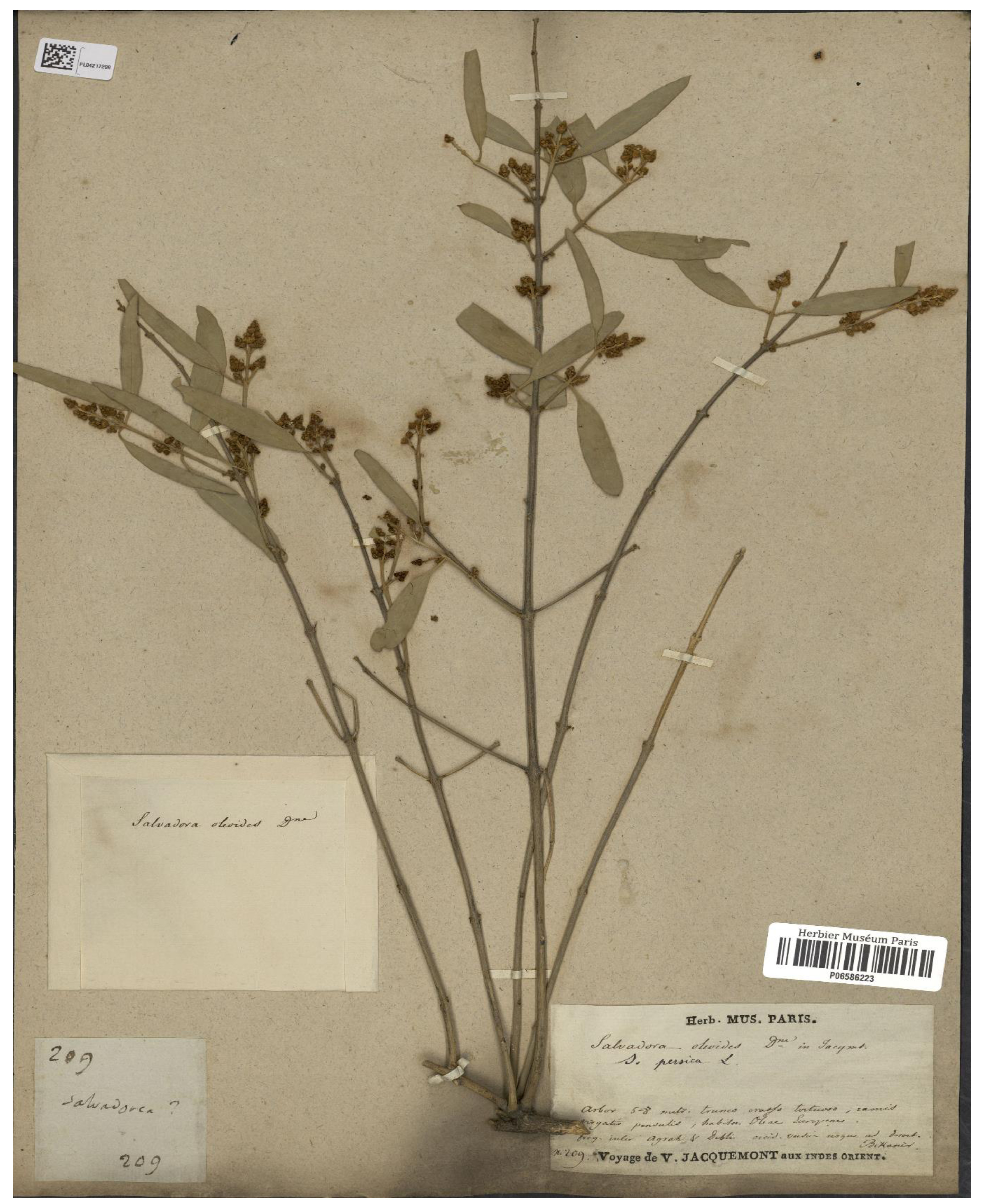
mustard tree
Salvadora persica L.

Salvadora persica, known as mustard tree, is a small evergreen tree of the Salvadoraceae family. It is native to regions including Angola, Algeria, India, and others, and is found in wooded savannah, open forest, and thicket habitats. The plant is used for making artefacts and as a food source. Its twigs, known as miswak, are traditionally used as a chewing toothbrush. The species is assessed as Least Concern (LC) by IUCN.
Description
Salvadora persica is a shrub or small tree occurring in various parts of Africa and Asia. It is commonly known as mustard tree and is part of the Salvadoraceae family. The species is found in habitats such as wooded savannah, open forest, and thicket. Local common names in Angola include kassosso, kimbungu, and muxi-ua-kimbungu. The plant has traditional uses, including the preparation of chewing sticks for oral hygiene. Taxonomically, there has been discussion regarding the lectotype designation, with Verdcourt and Riedl providing differing opinions on the correct specimen. The species was first published in 1753 by Linnaeus.
Other common names
toothbrushtreemustard treetoothbrush tree
Distribution
QA · Global · Algeria · Angola · Botswana · Burkina · Cameroon · Caprivi Strip · Chad · Djibouti · Egypt · Eritrea · Ethiopia · India · Kenya · Lebanon-Syria · Libya · Malawi · Mali · Mauritania · Morocco · Mozambique · Namibia · Nigeria · Niger · Northern Provinces · Oman · Pakistan · Palestine · Saudi Arabia
Synonyms
Lauridia multifloraRivina paniculataCissus arboreaEmbelia grossulariaGalenia asiatica