Japanese Hemlock
Tsuga sieboldii (Siebold & Zucc.) Carrière

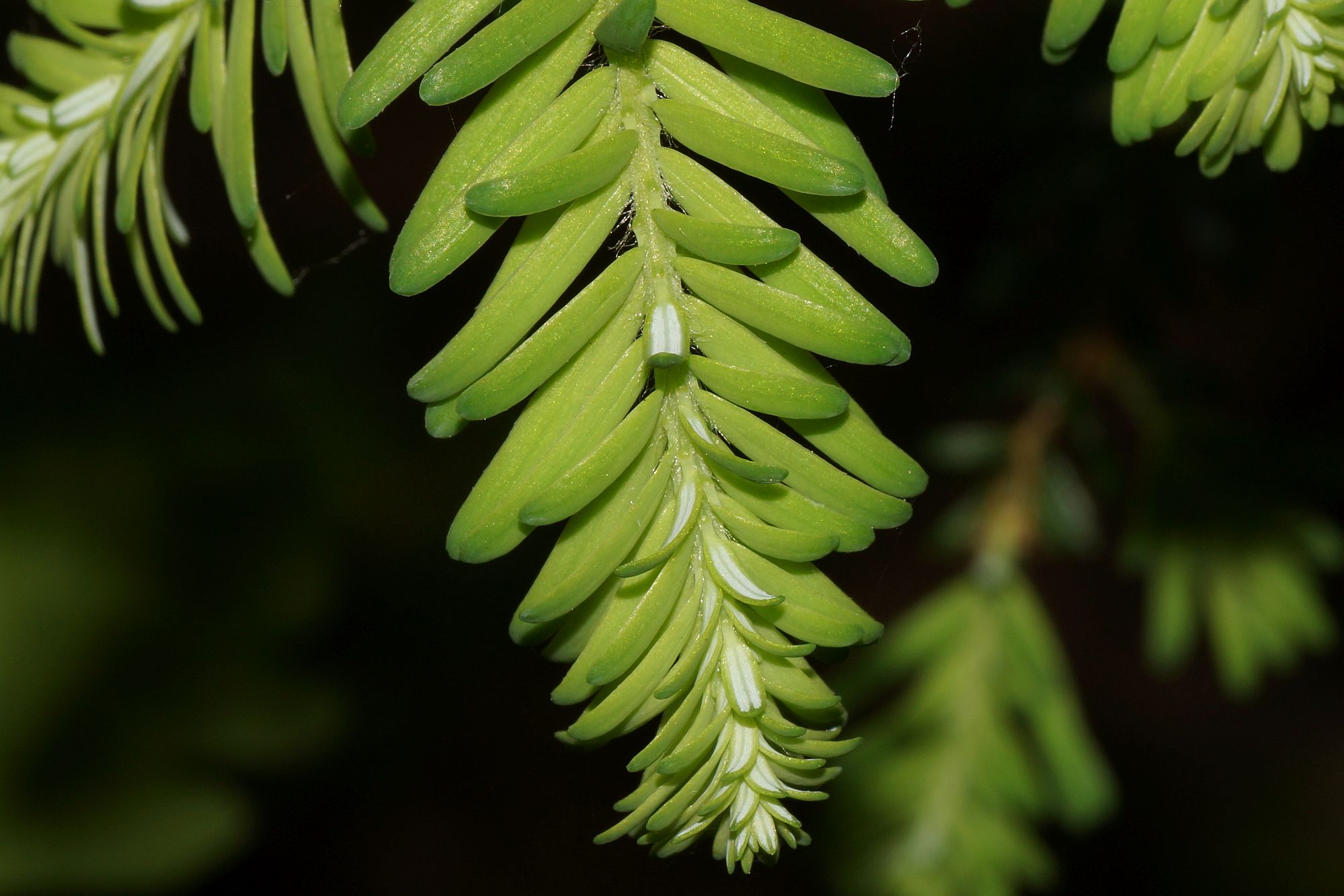
Tsuga sieboldii, known as Japanese Hemlock, is a conifer in the Pinaceae family. It is native to Japan, including Honshū, Kyūshū, Shikoku, and Yakushima. The tree can grow up to 30m tall with horizontal branches and an ovoid crown. Its leaves are linear, 13-20mm long, with a lustrous green upper surface and two whitish stomatal bands on the underside. Pollen cones are upright, and seed cones are ovoid, 15-20mm long, with yellowish brown seeds and wings. Pollination occurs in May, and seed maturity is in October. In Europe and North America, it is occasionally cultivated as an ornamental tree.
Description
Tsuga sieboldii is an evergreen tree with glabrous branchlets and yellowish brown coloration. The leaves are arranged loosely, with a 1mm petiole. Pollen cones are upright, and seed cones are pendulous, short-stalked, and ovoid. The species is distributed in southern Honshū, Shikoku, and Kyūshū. Taxonomic studies on Ulleungdo populations suggest morphological similarities with T. sieboldii, and the proposed new species T. uleungensis has been synonymized with T. sieboldii due to lack of distinct features. The species is cultivated outside its native range for ornamental purposes.
Other common names
Japanese HemlockSiebold HemlockSouthern Japanese Hemlock
Distribution
Global · Japan
Synonyms
Micropeuce sieboldiiTsuga araragiTsuga tsujaPinus sieboldiiPinus tsugaPinus araragiAbies araragiAbies hanburyanaAbies tsugaPinus tsuga var. nanaTsuga sieboldii var. nanaPinus araragi