Zamia sandovalii
Zamia sandovalii C.Nelson

Zamia sandovalii is a cliff-dwelling cycad in the family Zamiaceae, native to Atlántida, Honduras. It was described in 2007 by C. Nelson. The plant has a subterranean or decumbent stem, with a long taproot and coralloid roots. It typically grows on steep slopes and has 1–3 leaves per crown, which can be pendulous or arcuate depending on the terrain.
Description
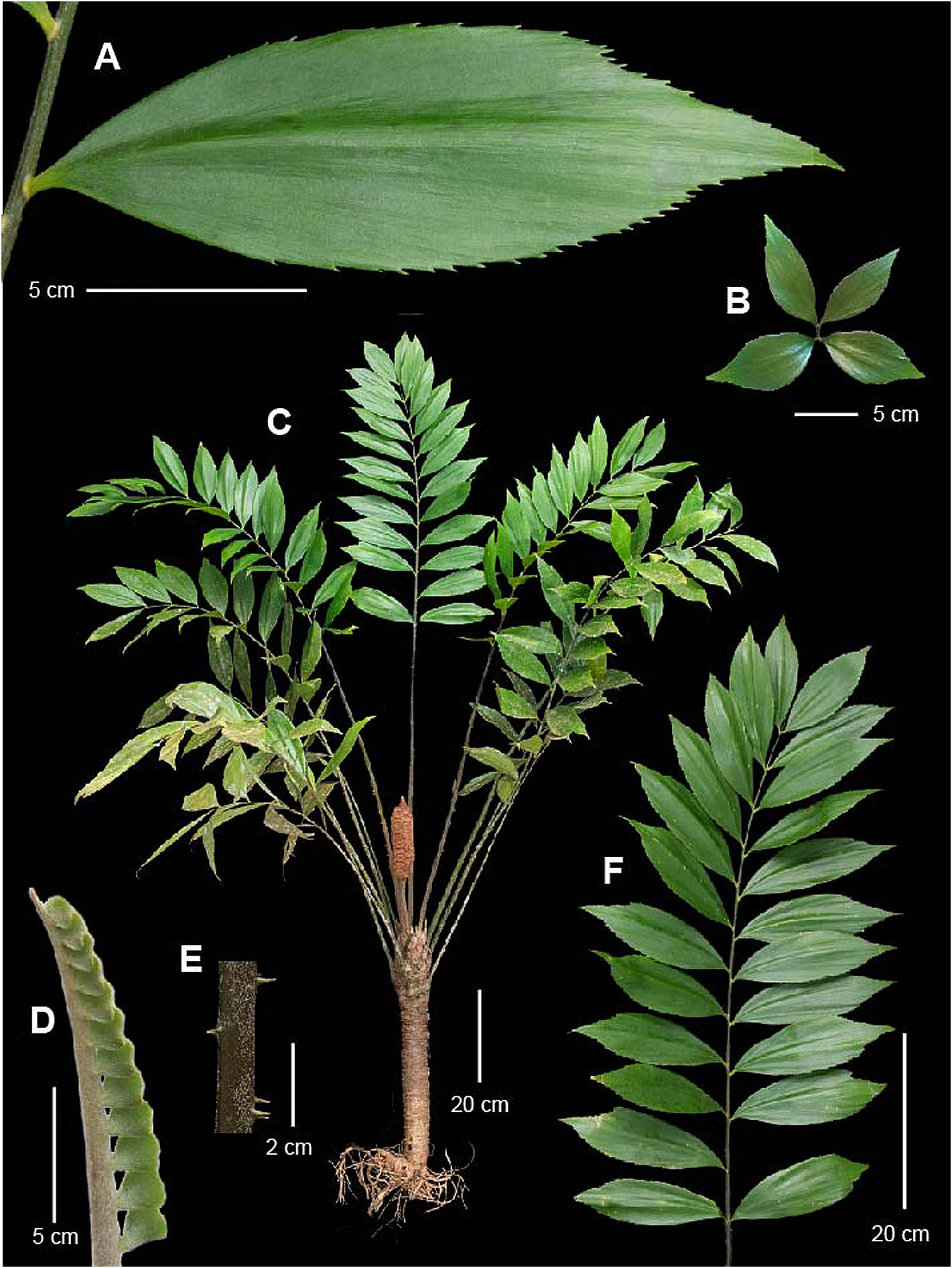
Zamia sandovalii is a cremnophytic cycad with a stem that is obovoid to napiform, measuring 15–25 cm in length and 12–15 cm in diameter. The stem may be entirely subterranean and lacks persistent leaf bases. It has a taproot up to 1 m long and 4–7 cm in diameter, with coralloid roots forming large, amorphous masses. The leaves are 1.5–2.2 m long and 50–75 cm wide, with a bulbous base and a medium green color. The petiole is 42–101 cm long and 0.8–2 cm in diameter, lightly armed with small prickles. The plant is typically found on steep gradients, with leaves that are pendulous, though they may be arcuate on level ground.
Distribution
Middle America · Global · Honduras