Tulipa fosteriana
Tulipa fosteriana W.Irving

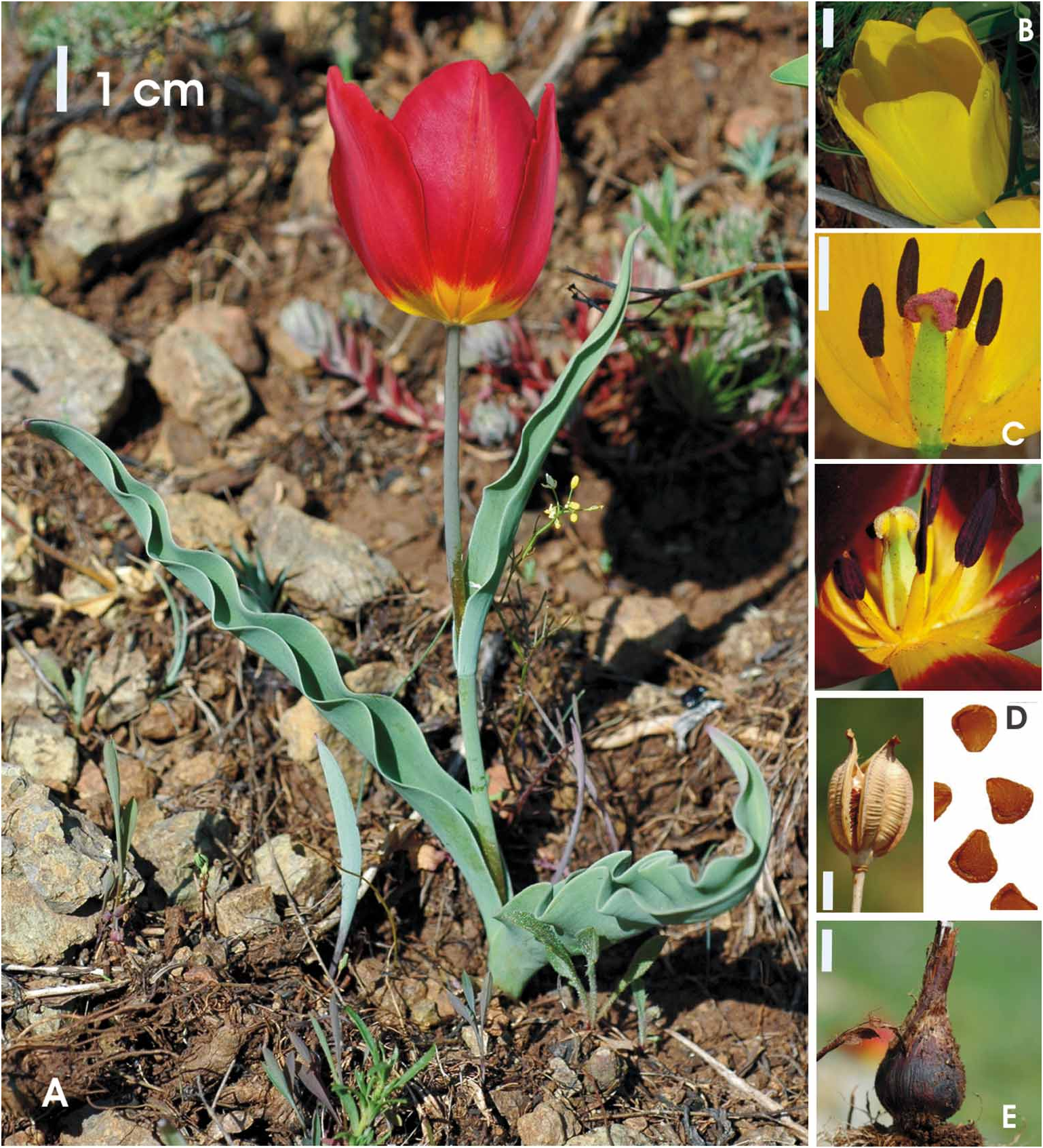
Tulipa fosteriana is a species of tulip in the Liliaceae family, native to the Pamir Mountains and regions of Afghanistan, Kyrgyzstan, Tajikistan, and Uzbekistan. It was described in 1906 by W. Irving and is known for its large, bright red flowers with a dark basal blotch. The species was named after Professor M. Foster and was first awarded by the Royal Horticulture Society in 1905. It grows in clayey, stony, and gravelly slopes at elevations of 1500–2600 m.
Description
Tulipa fosteriana has an ovoid bulb, 2–5 cm thick, with a blackish-brown, coriaceous tunic. The stem is 15–35 (50) cm long, robust, and glabrous, with pubescent upper parts. Leaves are 3–4 (6), large, deflexed, and glaucous or green, with ciliate margins. The solitary flower is large, cup-shaped, with bright red perigone segments 4.5–12.5 cm long. The basal blotch is typically three-pointed, black or violet, with a yellow margin. The ovary is green, and the capsule is 5–7 cm long. It is found in the Western Pamir-Alay and Afghanistan, likely introduced there. Specimens have been collected in Uzbekistan's Samarkand Mountains.
Distribution
SE · NO · Afghanistan · Kirgizstan · Tadzhikistan · Uzbekistan
Synonyms
Tulipa affinisTulipa victoris