Tulipa borszczowii
Tulipa borszczowii Regel

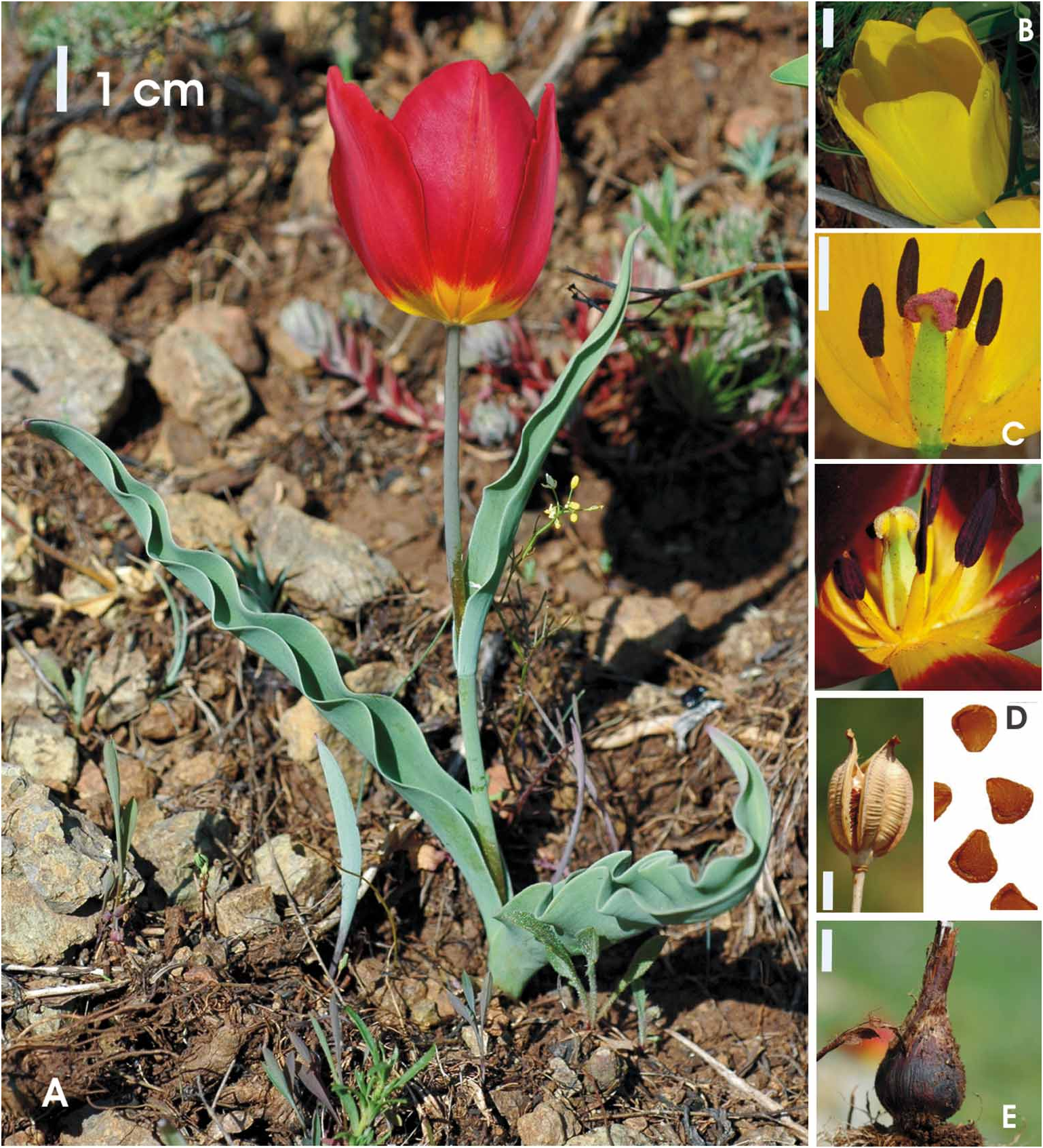
Tulipa borszczowii Regel is a member of the Liliaceae family, native to Kazakhstan and Uzbekistan. It grows in sandy, clayey, and stony deserts and relic mountain regions, typically at elevations up to 500 m above sea level. The species was named after the Russian botanist Borszczow, who first collected it in 1857 from the Aralo-Caspian region. In Uzbekistan, it was first recorded in 2002 from the western part of the Hungry Steppe and has since been found in seven locations, including the Kyzylkum Desert and the Muruntau and Kuldjuktau relic mountains. It occurs in yellow and red forms, with distinct populations in different regions.
Description
Tulipa borszczowii Regel has an ovoid bulb, 2–3 cm thick, with a tough, fibrous, black-brown to tawny tunic. The stem is 20–35 (–40) cm long, glabrous, and glaucous. Leaves are 3 (4), scattered, glaucous, strongly curled, and smooth-margined. The solitary flower has perigone segments that are yellow, orange, orange-red, or light red, with a dark violet blotch on both faces. The outer segments are rhomboidal, and the inner ones are slightly longer, obtriangular, and notched at the apex. Stigma is sessile, and the ovary is bluish-green. The species is found in the deserts of the Aral Sea region, Kyzylkum, and Betpakdala. Specimens are housed at TASH, including those from the Uzbekistan-Kazakhstan border regions.
Distribution
Kazakhstan · Uzbekistan
Synonyms
Tulipa glaucophyllaTulipa aurata