Tulipa bifloriformis
Tulipa bifloriformis Vved.

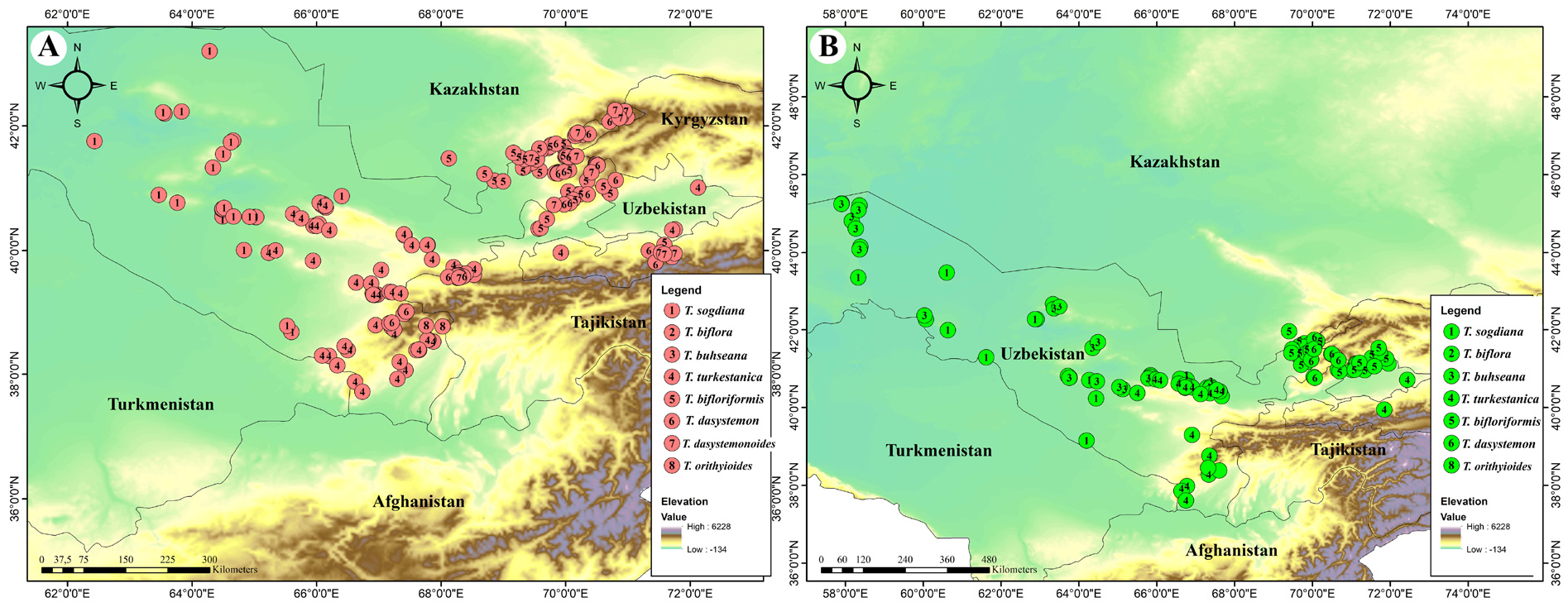
Tulipa bifloriformis is a Central Asian tulip species found in Kazakhstan, Kyrgyzstan, Tajikistan, and Uzbekistan. It grows in fine-earth, gravelly, and stony slopes at elevations between 500 and 2500 m. The species is characterized by an ovoid bulb, a stem 10–25 cm long, and two to eight flowers with white perigone segments yellow at the base. The name 'bifloriformis' refers to the two-flowered appearance. It is known to form dense thickets in natural habitats, especially in the Great Chimgan area. A dwarf cultivar, 'Starlight,' has received the Royal Horticultural Society's Award of Garden Merit.
Description
Tulipa bifloriformis belongs to the Liliaceae family and is native to the Western Tian-Shan region. The bulb is ovoid, 1.5–2.0 cm thick, with a reddish-brown, coriaceous tunic. The stem is 10–25 cm long, often pubescent. It has two deflexed, glabrous, ciliate leaves, with the lower one usually broader and exceeding the flower. The flowers are white with yellow bases, 15–30 mm long, with acute perigone segments. Outer segments are oblong-lanceolate, violet outside, and bearded at the base. The inner segments are oblong and acuminate. Stamens are about half the length of the perigone, with yellow filaments and violet or yellow-violet anthers. The ovary is short-styled, and the capsule is oblong. The species is often found in open slopes and can form dense carpets through vegetative spread.
Distribution
Kazakhstan · Kirgizstan · Tadzhikistan · Uzbekistan
Synonyms
Tulipa orthopoda