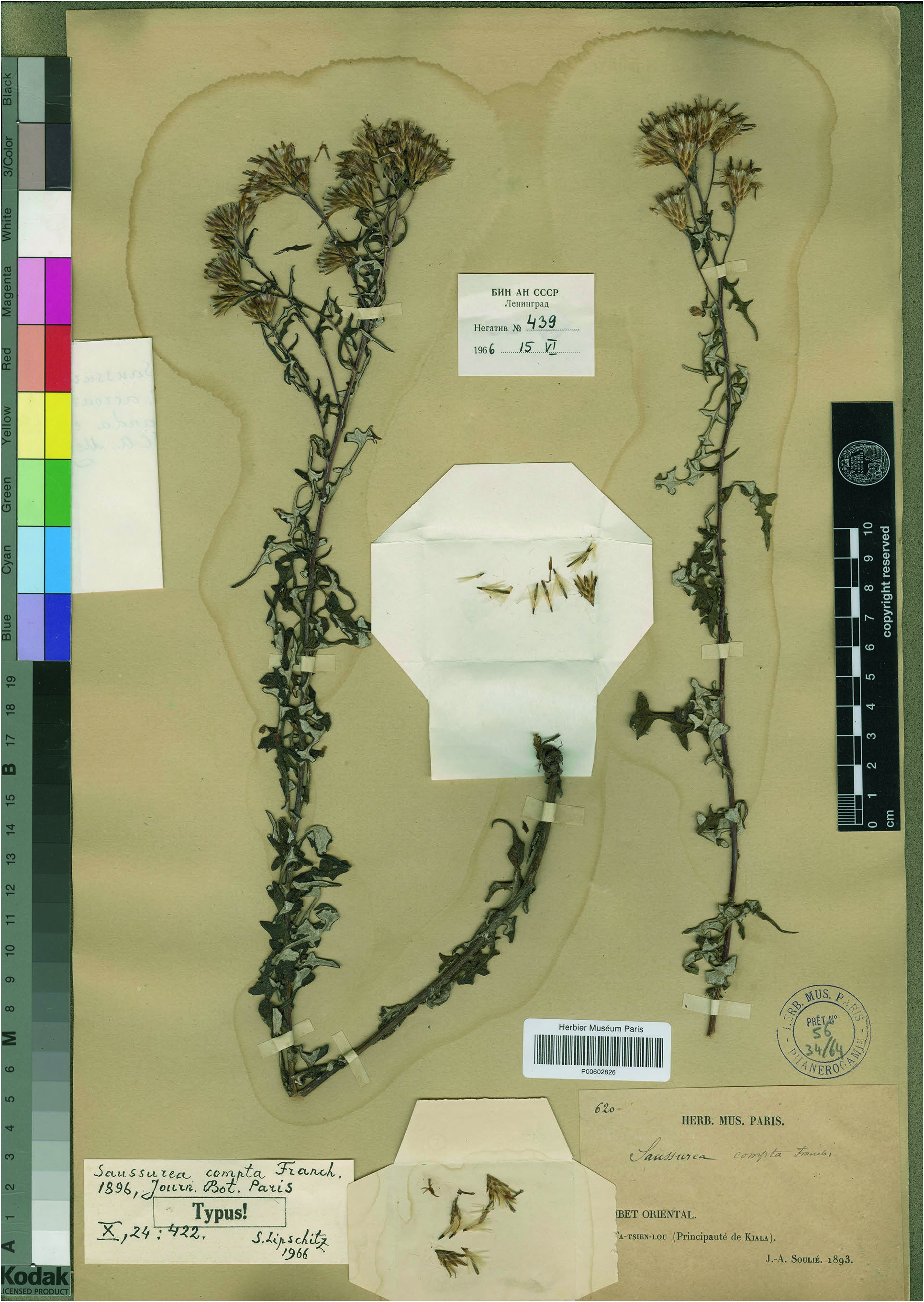
Tragopogon crocifolius
Tragopogon crocifolius L.

Tragopogon crocifolius is a member of the Asteraceae family, commonly known as the dandelion family. This species is an annual or biennial herb characterized by its fusiform rootstock and stems that can grow up to 80 cm tall. It is native to a wide range of regions in Europe and North Africa, including countries such as France, Spain, Italy, and Morocco. The plant is notable for its striking violet and yellow flower heads, and its achenes are distinctive for their tuberculate surface and clavate beaks.
Description
Tragopogon crocifolius is an herbaceous plant with a fusiform rootstock. The stems are 10-80 cm in height and may be simple or branched. The leaves are narrowly linear and only slightly widened at the base. The flower heads are supported by non-inflated peduncles, with involucral bracts numbering between 5 and 12. The outer ligules are typically violet with a yellow base, though they may occasionally be entirely violet or yellow. The inner ligules are yellow, sometimes with a violet tinge. The achenes are approximately 2 cm long, with a strongly tuberculate surface, a stout, clavate beak about as long as the body, and an annulus that is either glabrous or hairy. The pappus is about the same length as the achene.
Habitat
Tragopogon crocifolius is found in a variety of habitats, including meadows, roadsides, and disturbed areas. It is well adapted to temperate climates and thrives in regions with moderate rainfall and well-drained soils. The species is native to parts of southern and western Europe, as well as North Africa, and is often found in open, sunny environments.
Cultivation
This species is not commonly cultivated for ornamental or agricultural purposes. However, it can be grown in gardens that mimic its natural habitat, with well-drained soil and full sun exposure. It is relatively hardy and can tolerate a range of soil types, although it prefers loamy or sandy soils. Propagation is typically done from seed, which should be sown in early spring after the last frost.
Uses
Tragopogon crocifolius is not widely used in horticulture or agriculture. However, like many members of the Asteraceae family, it may have potential as a forage plant for livestock in certain regions. The plant is also of interest to botanists and ecologists due to its distribution and ecological adaptability. There is limited information on its medicinal or culinary uses, though some species in the genus may have been used traditionally in herbal medicine.
Distribution
Sardegna · Corse · Sweden · Morocco · Norway · France · Portugal · Spain · Sicilia · Algeria · Italy · Denmark · Finland · Switzerland · SE · CH · NO
Synonyms
Tragopogon crocifolius var. flaviflorusTragopogon crocifolius var. flocculosus