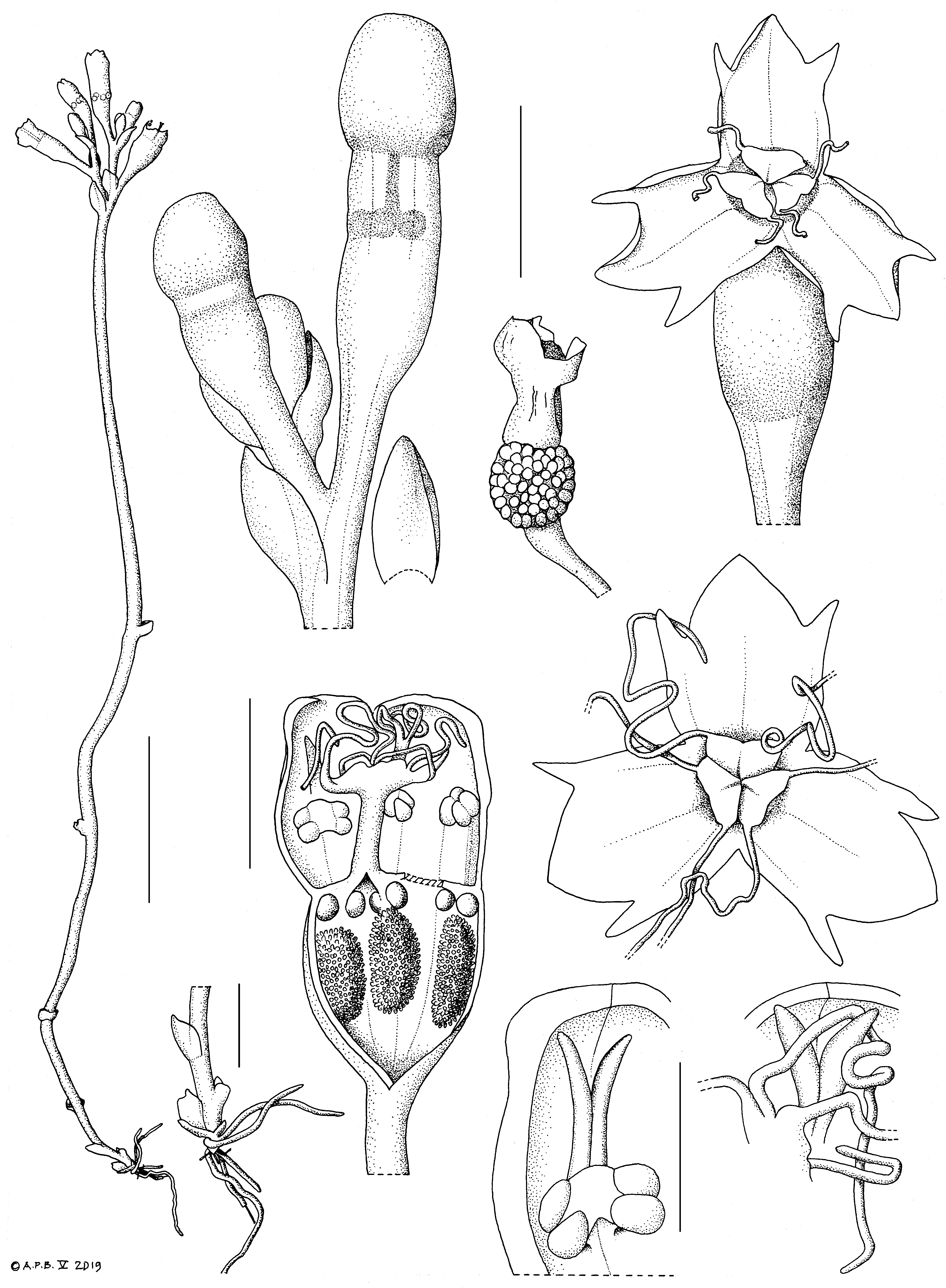
Thismia mantiqueirensis is a herbaceous plant in the Burmanniaceae family, native to Brazil (BR), described in 2022. It is characterized by a white to white-brownish, bisulcate stem, scale-like leaves, and a campanulate flower with a conical, pilose floral tube. The flower has six V-shaped calluses and tepals in two distinct morphologies. The species is closely related to T. glaziovii but differs in the absence of a fovea at the base of the floral tube, irregularly distributed pilose lamellae on the tepals, and anthers with an entire, rounded apex. It is classified in the subgenus Ophiomeris, section Ophiomeris, due to features such as a tuberous stem, distinct tepal arrangement, and parietal placentation. The species is named after the Mantiqueira mountains, its place of discovery.
Description
Thismia mantiqueirensis is a herb 4.3–12 cm tall, with 1–3.5 cm long, filiform, white roots and a 6–8 × 4 mm, cylindrical, brown tuber. The stem is 3.7–11.6 × 0.1–0.15 cm, sub-cylindrical, longitudinally bisulcate, and white to white-brownish. Leaves are 3–4, 2.5–4 × 1.5–2.5 mm, scale-like, verticillated near the flowers, and white. The flower is 14–25 × 9–11 mm, actinomorphic, campanulate, and sessile. The ovary is 2–3 × 3 mm, conical, with a white base and brown-orange stripes. The floral tube is 7–8 × 10–11 mm, conical, pilose, and orange with a blue base. Tepals are in two morphologies (3 + 3), with the shortest being obovate and the longest large-ovate. The anthers are 2.5 × 1 mm, with an entire, rounded apex. This species is distinguished from T. glaziovii by the absence of a fovea at the floral tube base, irregularly distributed pilose lamellae on tepals, and anthers with a rounded apex.