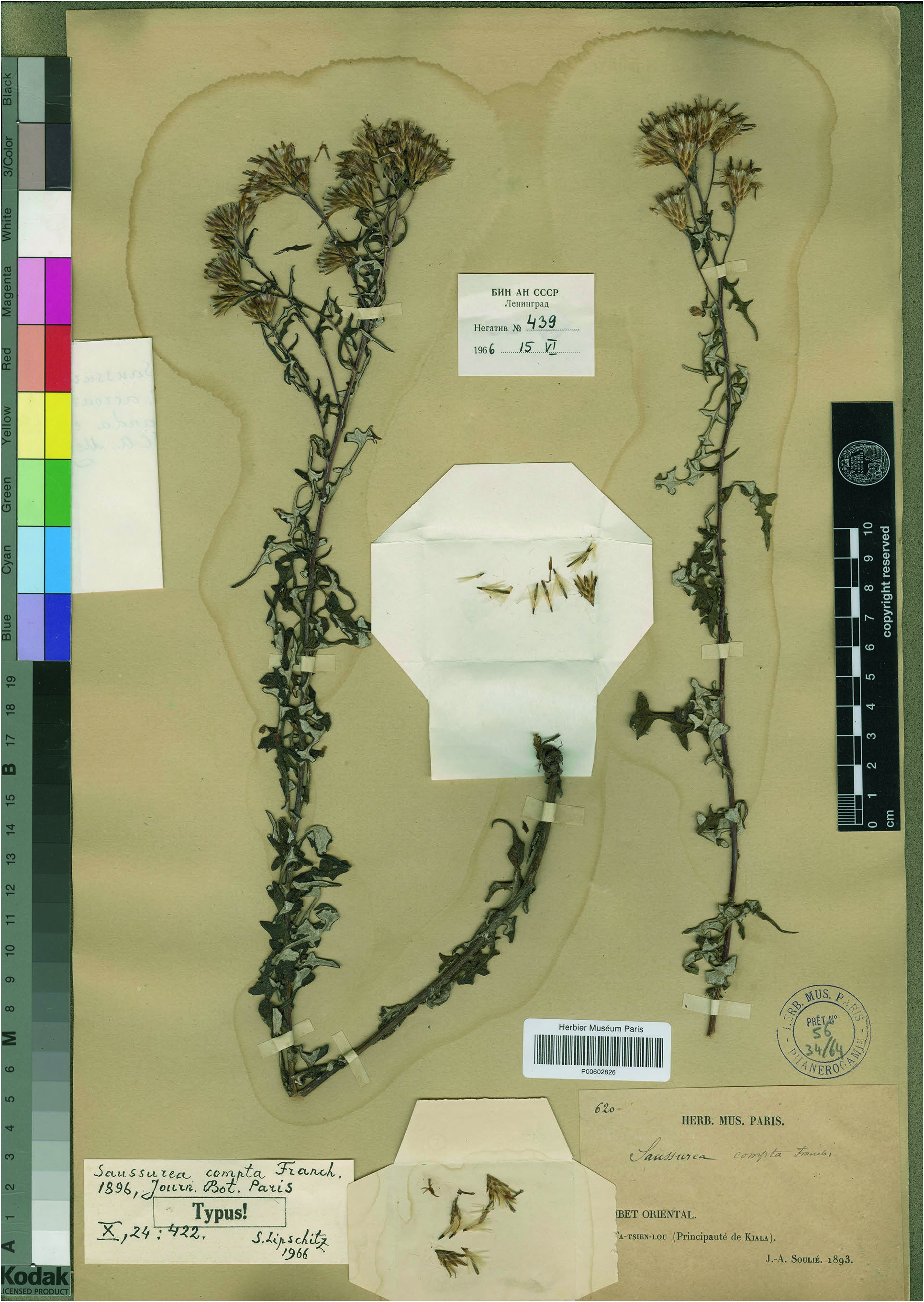
Strobocalyx arborea
Strobocalyx arborea (Buch.-Ham.) Sch.Bip.

Strobocalyx arborea is a species in the Asteraceae family, native to regions across South and Southeast Asia, including India, China, Indonesia, and the Philippines. It is a tree species reaching heights of 5 to 20 meters, characterized by its arborescent stems and elliptic to oblong leaves. The plant produces terminal or axillary capitulescences with narrowly campanulate involucres and funnel-shaped corollas in purple or white. Achenes are turbinate with twin hairs and capitate glands, and the pappus consists of two series of bristles.
Description
Strobocalyx arborea is a tree species found in tropical regions of Asia. It grows up to 20 meters tall with terete, ferruginous pubescent stems. The leaves are elliptic to oblong, 8–20 cm long, with a coriaceous texture and puberulous surfaces covered in filiform hairs and capitate glands. The capitulescences are thyrsoid paniculate, with narrowly campanulate involucres in 3–4 series and 2–3 mm long. Phyllaries are imbricate, green or purple, with piliferous margins. The florets number 3–6, with corollas 6–7 mm long and lobes approximately 2 mm long. Achenes are 2 mm long, 3–4-angled, and pubescent. The pappus has two series of bristles, with the inner bristles 6–7 mm long. Pollen is subechinolophate and 3-colporate.
Distribution
Global · Andaman Is. · Assam · Bangladesh · Borneo · China South-Central · China Southeast · India · Jawa · Laos · Malaya · Myanmar · Nepal · New Guinea · Nicobar Is. · Pakistan · Philippines · Sri Lanka · Sumatera · Thailand · Vietnam
Synonyms
Strobocalyx celebicaVernonia javanicaGymnanthemum arboreumStrobocalyx javanicaVernonia celebicaStrobocalyx blumeanaVernonia arborea var. celebicaVernonia javanica var. javanicaEupatorium javanicumLeucomeris celebicaVernonia urdanetense