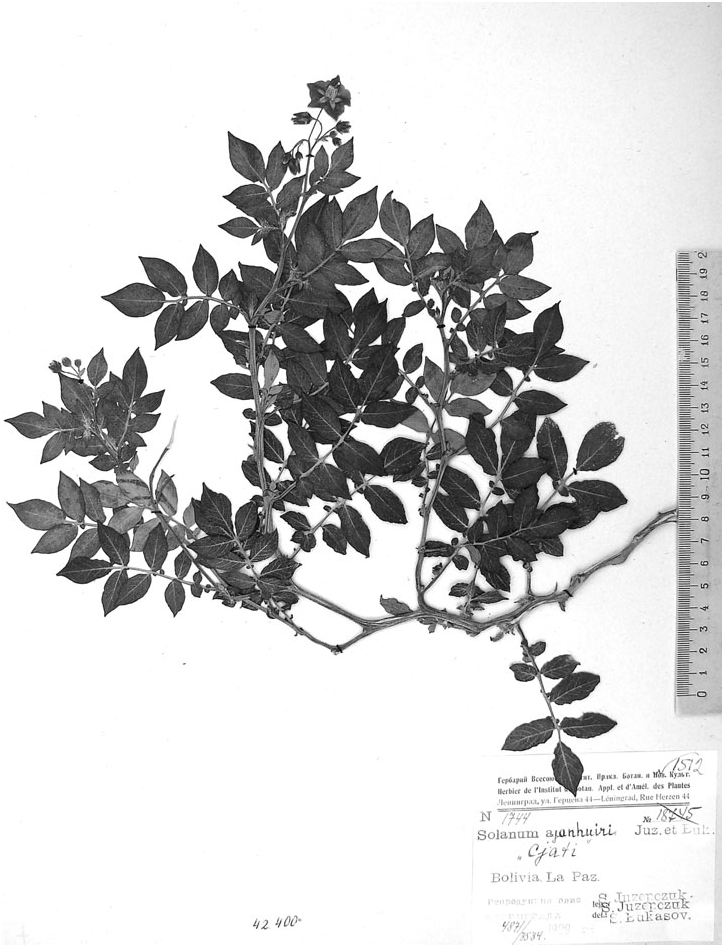
Solanum asterophorum
Solanum asterophorum Mart.

Solanum asterophorum is a shrub species native to Brazil, known for its variable morphology and wide latitudinal range. It belongs to the Solanaceae family and is part of the S. asterophorum species group within the subgenus Leptostemonum. The species is characterized by its erect branches, stellate trichomes, and downward-pointing flower buds. It is distinguished from closely related species by specific morphological traits, including leaf shape, inflorescence structure, and the orientation of its buds.
Description
Solanum asterophorum is a shrub that can grow up to 3 meters tall, with erect branches and young stems that are terete in shape. The stems are covered in stellate trichomes that can be sparse to dense, and these trichomes are hyaline to yellow or brown-tinged, with some becoming ochraceous near the meristems. The plant is moderately armed with prickles that are stramineous to brown, often turning ferruginous at the apex. The leaves are anisophyllous, with major leaves ranging from 10.5 to 29.5 cm in length and 5 to 20.5 cm in width, and are elliptic to obovate in shape. The leaves are lobed, with 1 to 6 lobes per side, and have a base that is narrowly cuneate to cuneate. The inflorescences are congested, and the flower buds are held downward due to the obconic calyces and curved pedicels.
Habitat
Solanum asterophorum is native to the northeastern and southeastern regions of Brazil, with a distribution that spans from Rio de Janeiro to Paraíba. It is adapted to a range of habitats within these regions, though specific ecological preferences are not well-documented. The species is likely found in a variety of soil types and light conditions, given its wide latitudinal range and morphological variability.
Cultivation
Cultivation details for Solanum asterophorum are limited, but as a member of the Solanaceae family, it likely requires well-drained soil and moderate watering. The plant's erect growth habit and stellate trichomes suggest it may be adapted to some degree of aridity or high light exposure. Propagation could be achieved through cuttings or seeds, though specific germination requirements are not known. Due to its variable morphology, care should be taken to maintain the specific characteristics of the plant when cultivating it.
Uses
There are no known traditional or commercial uses for Solanum asterophorum. As a member of the Solanaceae family, some species are used for medicinal or ornamental purposes, but no such uses have been documented for this particular species. Its primary value lies in its botanical significance and potential for use in taxonomic and ecological studies.
Distribution
BR · Brazil Northeast · Brazil Southeast
Synonyms
Solanum asterophorum var. asterophorumSolanum asterophorum var. tomentosumSolanum gomphoidellumSolanum melancholicumSolanum scaberrimumSolanum tetricum