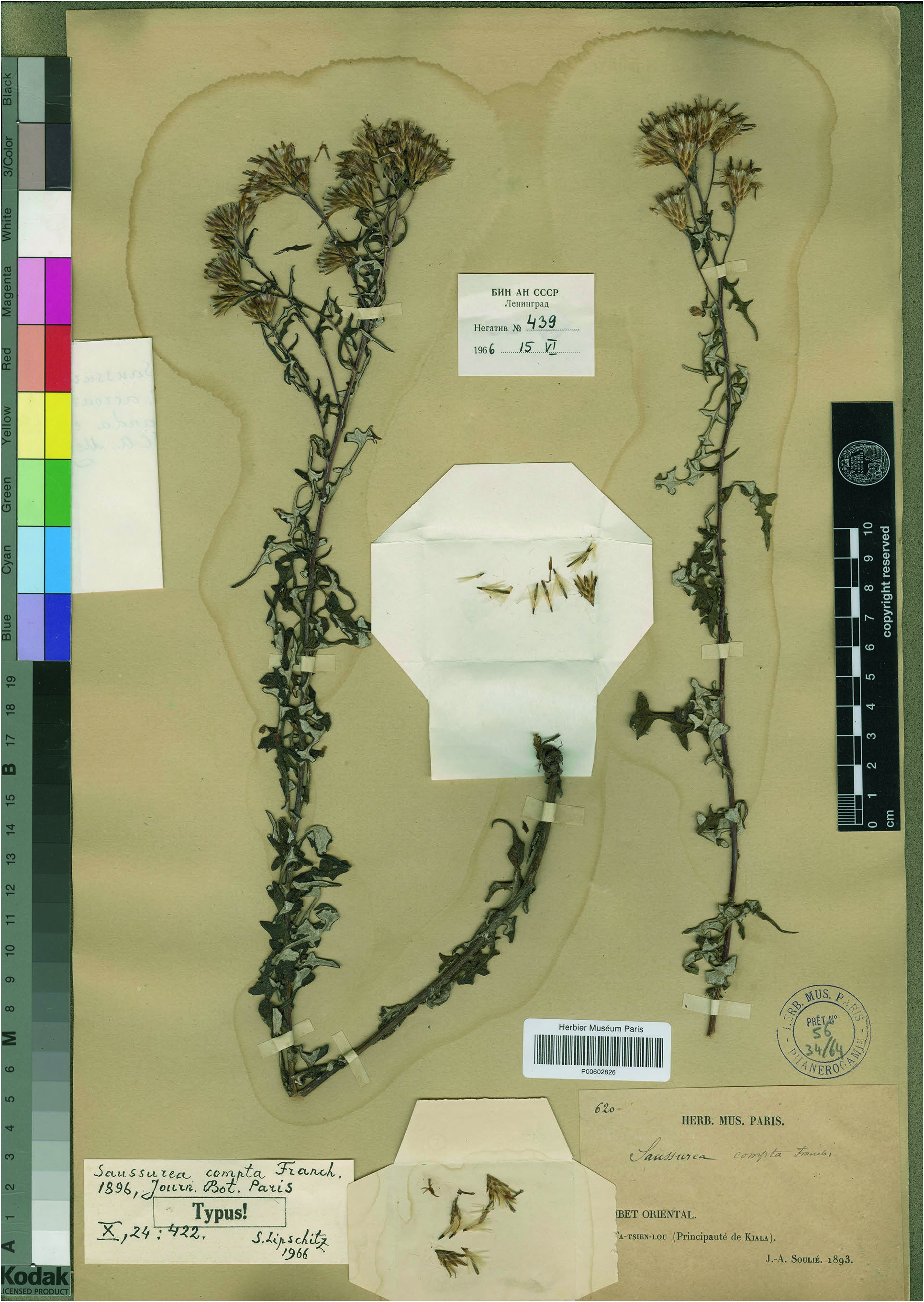
Santolina oblongifolia
Santolina oblongifolia Boiss.

Santolina oblongifolia, described by Boiss. in 1856, belongs to the Asteraceae family. The lectotype features two flowering stems and one sterile stem, with leaves on the sterile stem broadly spatulate and those on flowering stems narrowly spatulate. The capitula are poorly preserved, preventing a full assessment of bract count and hybrid characteristics. The specimen likely comes from a mixed population at an altitude below 1800 m, possibly near Casatejada, Cáceres, though this location is outside the typical altitudinal range for the species.
Description
The lectotype of Santolina oblongifolia shows morphological traits consistent with populations at lower altitudes. Flowering stems are not significantly widened at the tip, and the observed widening is likely due to preservation issues. The sterile stem displays broadly spatulate leaves, a feature common in high-altitude populations. The damaged capitula and bracts hinder a full analysis of hybrid features. The specimen is thought to originate from a mixed population including S. oblongifolia and S. rosmarinifolia subsp. rosmarinifolia. Rivas Goday (1955) suggests the original material may have been collected near Casatejada, Cáceres, which lies south of the Central System at low elevation, potentially outside the species’ usual altitudinal range.
Distribution
Global · Spain
Synonyms
Santolina oblongifolia var. oblongifolia