Macroptilium martii
Macroptilium martii (Benth.) Maréchal & Baudet

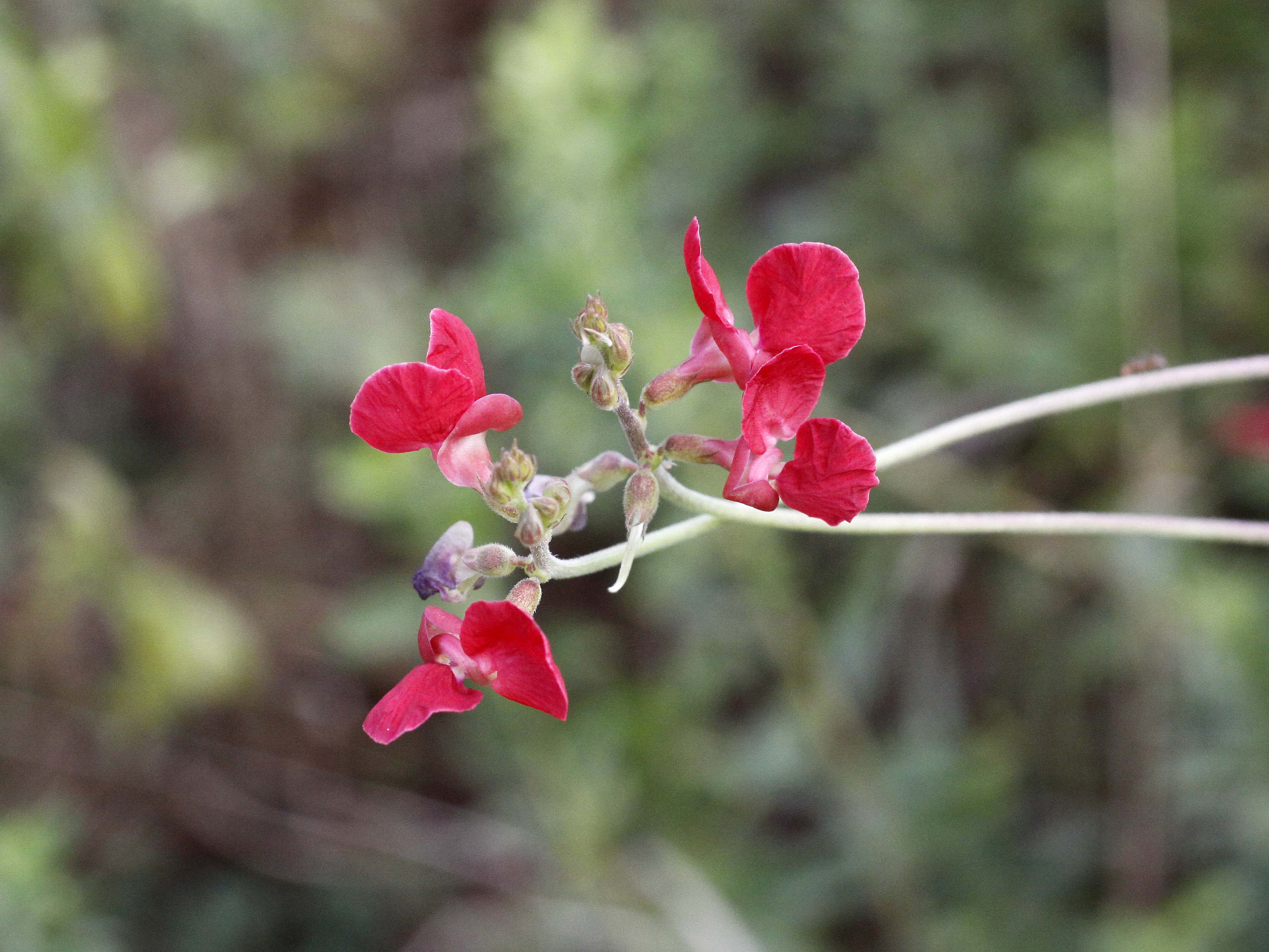
Macroptilium martii is a climbing legume species native to the semi-arid regions of northeastern Brazil, as well as parts of Bolivia and Paraguay. It is distinguished by its vine-like growth, ovate leaflets, red papilionaceous flowers, and cylindrical legumes. The species is commonly known as 'orelha de onça' due to the rounded shape of its leaflets, which resemble small ears.
Description
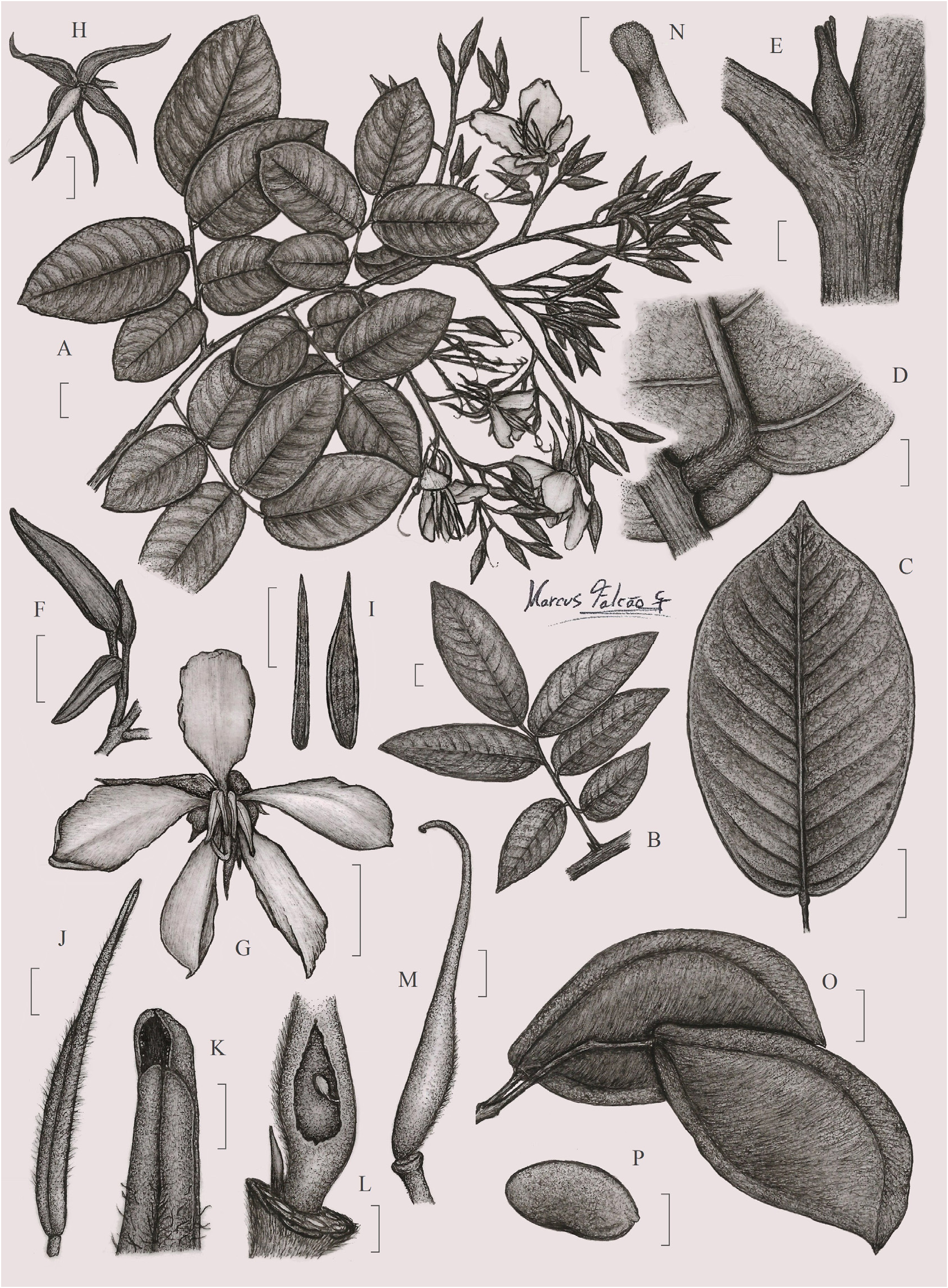
Macroptilium martii is a climbing shrub with tomentose branches and inermous stems. The leaves are imparipinnate with three opposite, ovate leaflets and actinodromous venation. The inflorescence is an axillary raceme with pedicellate, asymmetric, red flowers. The flowers are diplostemonous with a gamosepalous calyx of five sepals and a dialypetalous, papilionaceous corolla of five petals. The androecium is diadelphous and heterodinamous, with anthers dehiscing longitudinally. The ovary is superior, sessile, and pluriovulate. The fruit is a linear, cylindrical legume with a straight margin and a tomentulose, brown epicarp. The seeds are reniform, turgid, and have a marbled coat with a central hilum.
Habitat
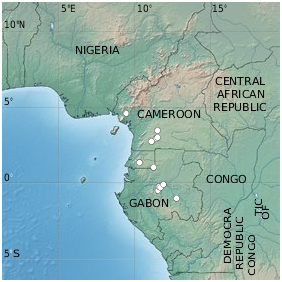
This species is found in the semi-arid regions of northeastern Brazil, particularly in the state of Paraíba, as well as in Bolivia and Paraguay. It is adapted to the conditions of the Caatinga biome, a tropical dry forest characterized by seasonal drought and nutrient-poor soils. Macroptilium martii thrives in open, scrubby vegetation and may be associated with rocky outcrops or sandy soils typical of the region.
Cultivation
Macroptilium martii is not commonly cultivated, but its adaptability to arid environments suggests potential for use in ecological restoration or as a drought-tolerant ornamental in semi-arid landscapes. Propagation can likely be achieved through seed, though specific germination requirements are not well documented. The plant's climbing habit may require support structures in cultivation. Due to its native habitat, it is best suited for regions with low to moderate rainfall and well-drained soils.
Uses
While no specific economic uses for Macroptilium martii are widely reported, the species may contribute to local biodiversity and soil stabilization in its native range. Its leguminous nature suggests a potential role in nitrogen fixation, though this has not been studied in detail. The plant is known locally as 'orelha de onça,' indicating some level of recognition within traditional knowledge systems, though no documented medicinal or agricultural uses have been reported.
Distribution
BR · Bolivia · Brazil Northeast · Paraguay
Synonyms
Phaseolus martii