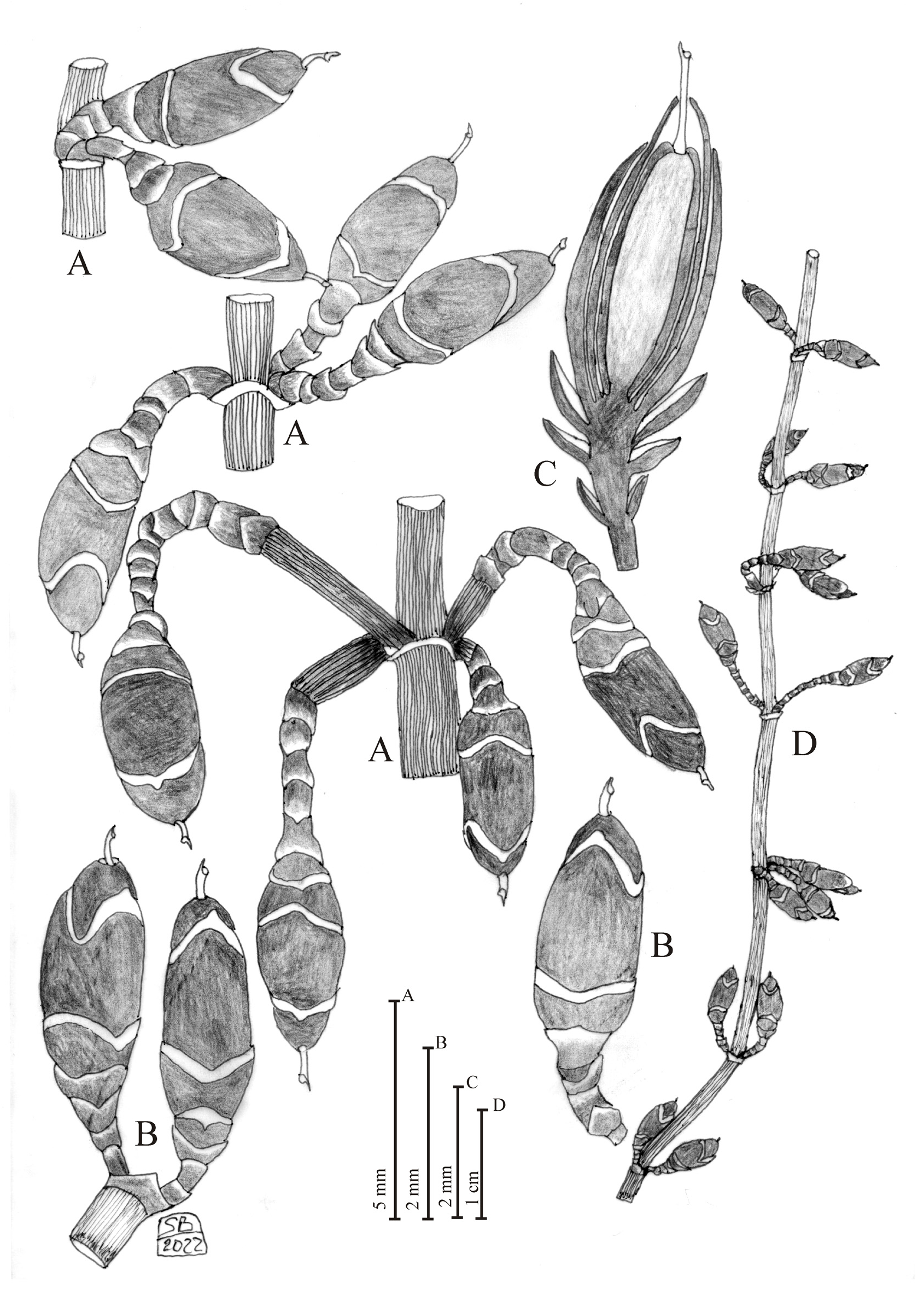
Ephedra intermedia
Ephedra intermedia Schrenk & C.A.Mey.

Ephedra intermedia is a species of shrub in the Ephedraceae family, native to regions across Siberia, Central Asia, Iran, Afghanistan, Pakistan, the western Himalayas, Tibet, Mongolia, and China. It is an erect to procumbent shrub, reaching heights of 30–200 cm, with green branchlets and bark that is brownish black, longitudinally fissured, and sheathed. It has upright green stems with alternating ridges and furrows. The species flowers from May to July and fruits from July to September.
Description
Ephedra intermedia is characterized by its 30–200 cm tall shrubs or sub-shrubs with green branchlets and brownish black, longitudinally fissured bark. The stems are upright with alternating ridges and furrows, and stomata are located in furrows while cuticular papillae are found on ridges. Leaves are 2–3 per node, 2–6 mm long, and mostly fused. Strobili are typically axillary, bi- to trimerous, and range from sessile to pedunculate. Male strobili are orange to yellow, while female strobili are oval and yellowish green. Fruits are fleshy, oblong to ovoid, and colored red, orange, or yellow. The species was first described in 1845 and is known by the Chinese common name Zhong Ma Huang.
Distribution
Global · Belgium · Flemish Region · Afghanistan · Altay · Inner Mongolia · Iran · Kazakhstan · Kirgizstan · Mongolia · Pakistan · Tadzhikistan · Tibet · Transcaucasus · Turkmenistan · Uzbekistan · West Himalaya · West Siberia · Xinjiang
Synonyms
Ephedra ferganensisEphedra glaucaEphedra heterospermaEphedra intermedia var. glaucaEphedra intermedia var. persicaEphedra intermedia var. schrenkiiEphedra intermedia var. tibeticaEphedra microspermaEphedra persicaEphedra tesquorumEphedra tibeticaEphedra validaEphedra vulgaris var. submonostachysEphedra sumlingensisEphedra khurikensisEphedra pangiensis