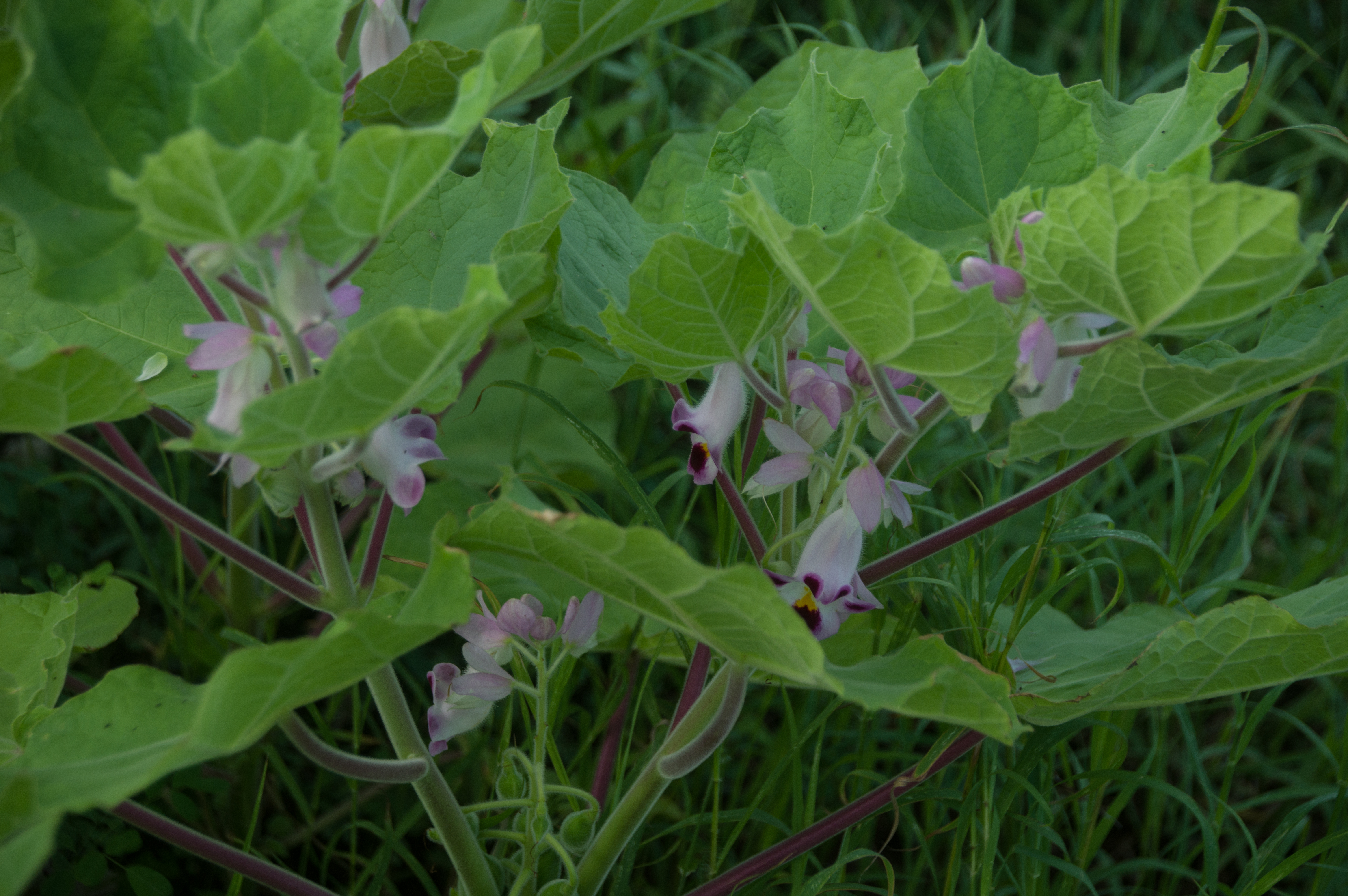
doubleclaw
Proboscidea parviflora (Wooton) Wooton & Standl.

Proboscidea parviflora, known as doubleclaw, is a flowering plant in the family Martyniaceae. Native to the desert southwest of the United States and northern Mexico, it thrives in sandy, dry, and disturbed habitats. This annual herb features sprawling stems, leaves up to 15 cm long, and bell-shaped flowers that are white to pink or purple. The fruit is a seed pod with a long, curving tail that splits into two claw-like halves when dry. It was used for food and basketry by local Native Americans.
Description
Proboscidea parviflora is an annual herb in the Martyniaceae family, native to the desert southwest of the United States and northern Mexico. It grows in sandy, dry, and disturbed areas, blooming during the hot summer. The plant has sprawling stems and leaves with rounded, oval, or triangular blades up to 15 cm long. The inflorescence consists of several bell-shaped flowers with five flaring lobes, colored white to pink or purple, often with a purple blotch on the upper lip and a yellow nectar guide on the lower lip. The fruit is a long seed pod with a cylindrical body and a thin, curving tail that splits into two hooked halves when dry. The young fruits and seeds were consumed, and the hardened dry fruits were used in basketry by local Native Americans.
Other common names
doubleclaw
Distribution
Arizona · California · Mexico Central · Mexico Northeast · Mexico Northwest · Nevada · New Mexico · Sudan · Texas · Utah
Synonyms
Martynia parviflora