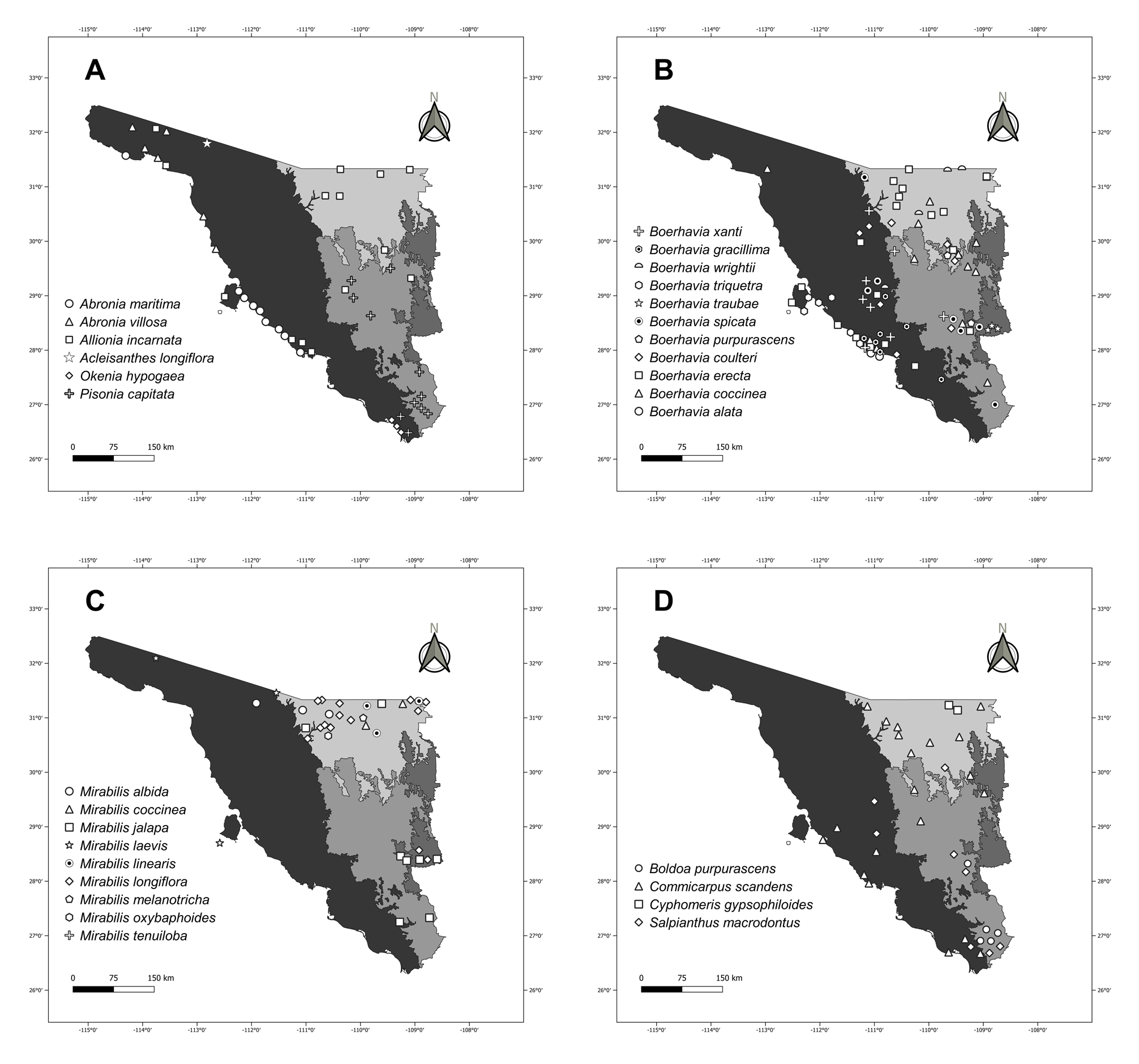
Boerhavia coulteri is a flowering plant in the Nyctaginaceae family, native to the southwestern United States and northern Mexico. It is an annual herb with erect or creeping stems up to 70–80 cm long, slightly hairy with sticky resin glands at the base. The lance-shaped or triangular leaves, up to 5 cm long, are mostly found on the lower half of the plant. The inflorescence is a small cluster of tiny white to pale pink flowers, each under 2 mm long. The fruit is an elliptical body with longitudinal ribs, a few millimeters in length, borne in small clusters. The species was first described as Senkenbergia coulteri by Bentham & Hooker in 1880 and later transferred to the genus Boerhavia by S. Watson in 1889. A neotype was designated for the species in 2021 due to a lack of original material for lectotypification.
Description
Boerhavia coulteri is commonly known as Coulter's spiderling. It is found in Arizona, California, New Mexico, Texas, Utah, and parts of Mexico. The plant thrives in desert areas and is characterized by its sticky, glandular stems and small, clustered flowers. The leaves are typically lance-shaped or triangular, with wavy or rippled edges. The plant produces small, elliptical fruits with longitudinal ribs. The species was originally described under the genus Senkenbergia by Bentham & Hooker in 1880, but Watson reclassified it into the genus Boerhavia in 1889. A neotype was designated for the species in 2021 based on a specimen collected by Coulter in Mexico, as no original material was available for lectotypification.
Other common names
Coulter's spiderling
Distribution
Arizona · California · Mexico Northeast · Mexico Northwest · Mexico Southwest · New Mexico · Texas · Utah
Synonyms
Boerhavia coulteri var. palmeriBoerhavia palmeriBoerhavia spicata var. palmeriSenkenbergia coulteriBoerhavia coulteri var. coulteri