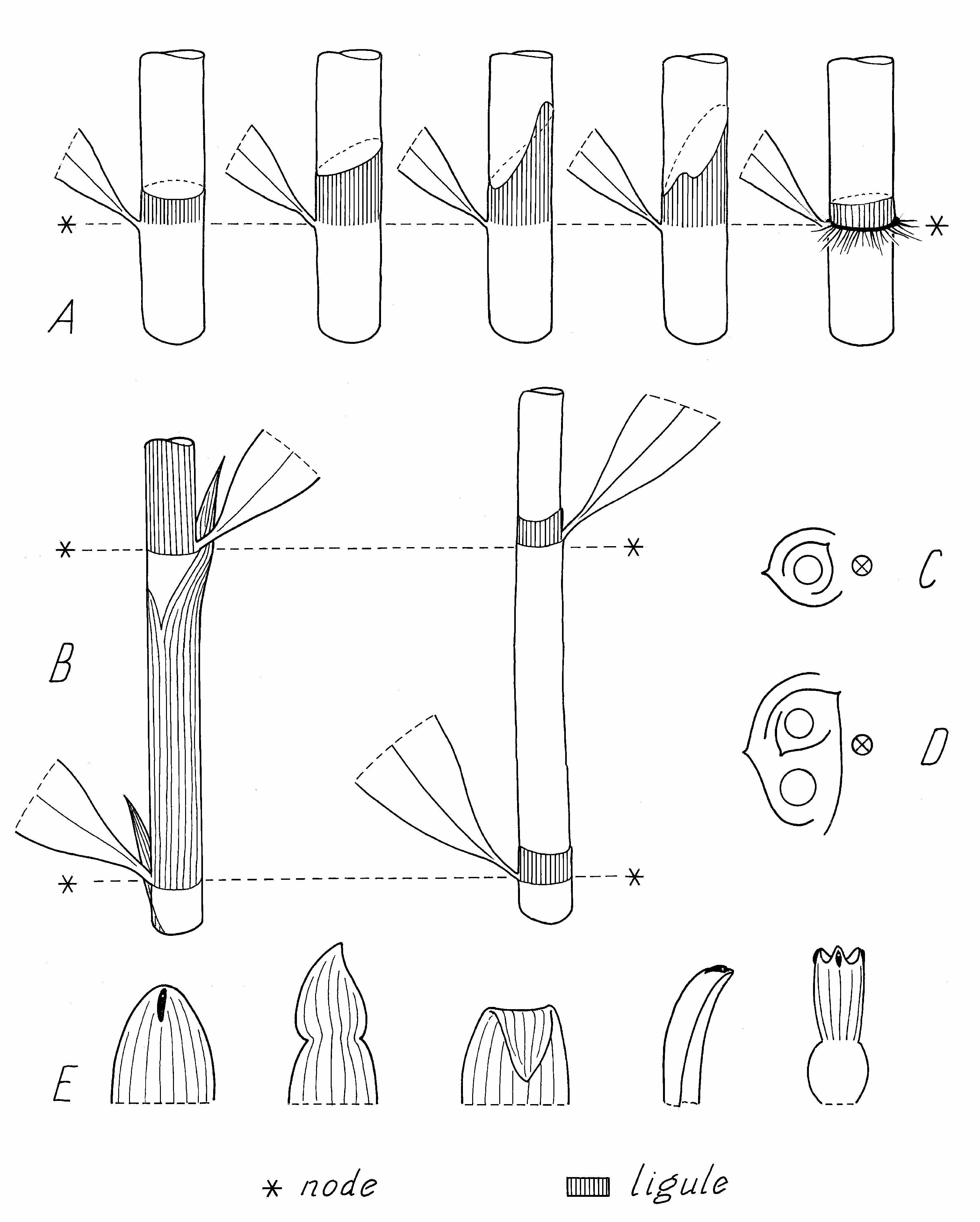
Costus lucanusianus is a terrestrial herb in the family Costaceae, native to various regions of Africa. It grows in savanna forest, secondary forest, swamp forest, and other habitats, at elevations from 0 to 1700 m. The plant can reach 1–5 m in height, with leaves that are narrowly elliptic and densely to sparsely covered in silvery hairs on the underside. The inflorescence is many-flowered, broadly ovoid to globose, and the flowers have horizontally spreading to reflexed calyx lobes. The species is distinguished by a row of distinct erect hairs on a horizontal rim at the base of the short ligule, and by boat-shaped bracteoles. It is sometimes confused with C. afer but can be differentiated by the complete ring of hairs on the nodes, the hairy underside of the leaves, and the reflexed calyx lobes.
Description
Costus lucanusianus is a tall, erect herb that often bends when fruiting. The plant is commonly viviparous, with seedlings emerging from ripe fruits as the infructescence touches the ground. Leaves are numerous, with sheaths 0.5–2 cm in diameter, and a ligule that is truncate to slightly 2-lobed, 1–4 mm long, and has a horizontal rim with needle-like hairs. The lamina is narrowly elliptic, 12–33 cm long and 3–10 cm wide, with an acuminate apex. The inflorescence is 2–12 cm long and 2–9 cm wide, with green, coriaceous bracts. Flowers are 2 per bract, with a calyx 18–25 mm long and lobes that are broadly ovate-triangular to triangular. The species is found in wet areas such as riverbanks, roadsides, and plantations, and it flowers and fruits throughout the year.