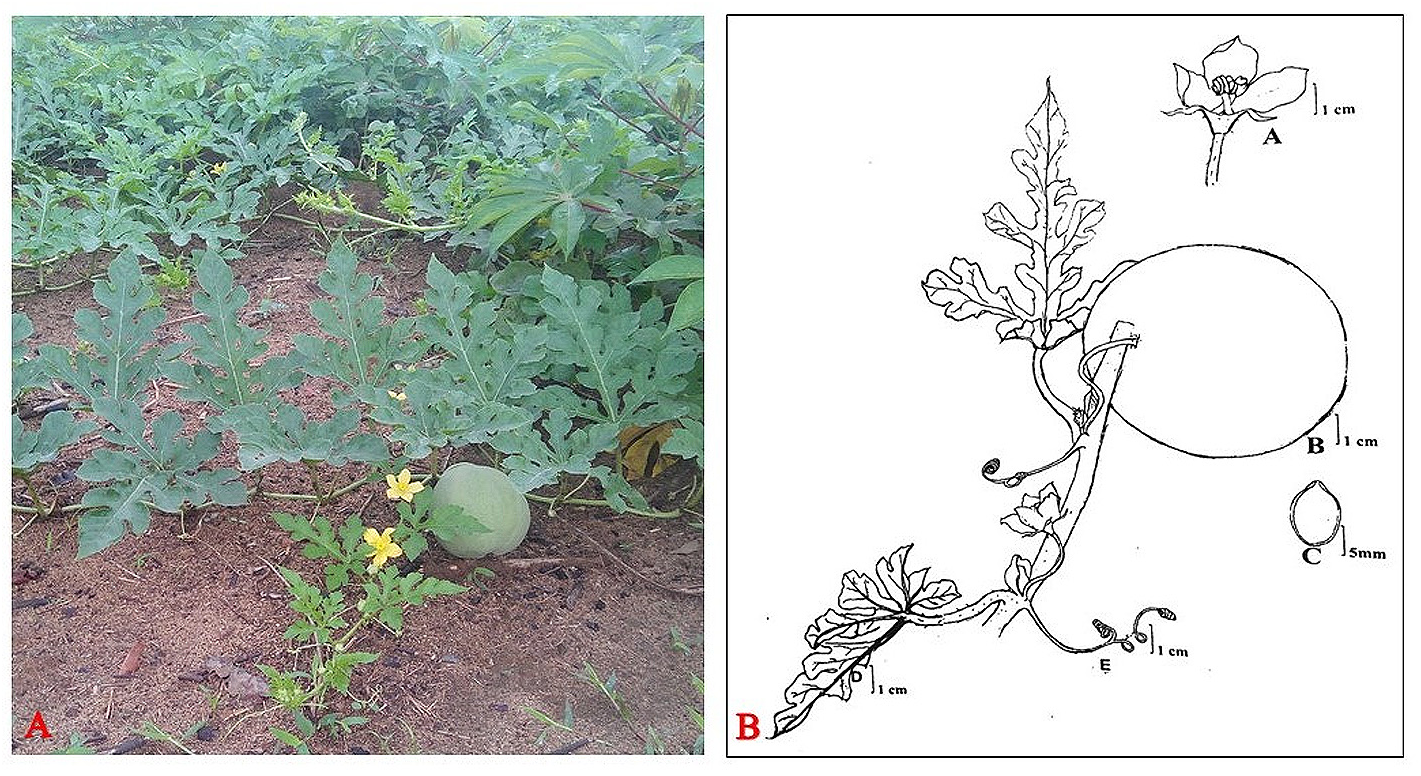
Coccinia trilobata
Coccinia trilobata (Cogn.) C.Jeffrey

Coccinia trilobata is a perennial climbing plant in the Cucurbitaceae family, native to Kenya and Tanzania. It was described in 1962 by C.Jeffrey. The plant has stems up to 3 m long, with soft, whitish trichomes, and leaves that are cordate to 5-lobed with denticulate margins. The upper leaf surface has white pustules and trichomes, while the lower surface is densely covered with soft trichomes. It produces male and female flowers, with male flowers being solitary or in short racemes and female flowers typically solitary. The flowers are orange-yellow to reddish-orange with green venation. The fruit is ovoid to oblong, green when unripe with white longitudinal stripes.
Description
Coccinia trilobata is a perennial climber in the gourd family, Cucurbitaceae, found in Kenya and Tanzania. It has stems up to 3 m long, with soft, whitish trichomes, particularly along the nerves. The petioles are 1.5 to 16.5 cm long and also bear whitish trichomes. Leaves measure 2.6 to 14.5 cm in length and 3.2 to 18 cm in width, with a cordate shape that can be 5-angulate to 5-lobate. The leaf margins are denticulate, and the apex of the central lobe is acute or acuminate. The upper leaf surface is marked by hyaline to white pustules and white trichomes, while the lower surface is covered with soft trichomes, denser on the nerves. Male flowers appear solitary or in short, few-flowered racemes, with pedicels up to 3.2 cm long. Female flowers are typically solitary, with a pedicel of 0.5 to 4 cm. The flowers have an orange-yellow to reddish-orange corolla with green venation. The fruit is ovoid to oblong, 4 to 4.7 cm long, with a green unripe surface and white longitudinal stripes.
Distribution
Kenya · Tanzania
Synonyms
Coccinia kilimandjaricaPeponia trilobataPeponium trilobatumPeponia parviflora var. trilobata