Cichorium pumilum
Cichorium pumilum Jacq.

Cichorium pumilum is a low-growing, annual herb native to the Mediterranean region and parts of the Middle East, belonging to the daisy family Asteraceae. It is characterized by its slender taproot, branched stems, and bluish-violet flower heads. The species is commonly found in dry, rocky habitats and is known for its edible leaves and roots. It was first described in 1771 by the botanist Johann Jacob Dillenius.
Description
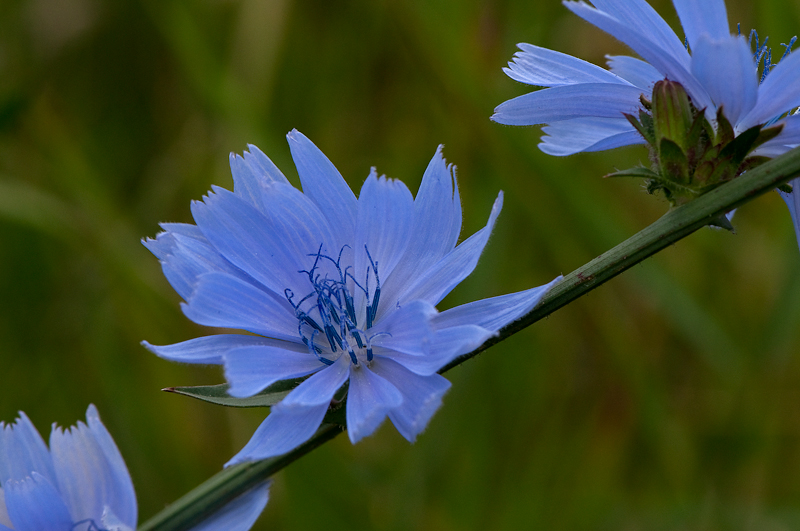
Cichorium pumilum is an annual herb with a slender, fibrous taproot and a stem that can grow up to 40 cm in height. The plant typically has a main stem with 2-3 lateral branches or, less commonly, branches from the base. Basal leaves are ovate to obovate in shape, ranging from 2.5 to 20 cm in length and 0.7 to 4 cm in width, with irregularly dentate to deeply incised margins. These leaves are glabrous or slightly pubescent. The cauline (stem) leaves are smaller, ovate, and have entire to dentate margins. The plant produces solitary or clustered flower heads, which are either sessile or borne on peduncles up to 10 cm long. The involucral bracts are reflexed, with the lower portion fleshy and the upper part acute to acuminate, often bearing glandular or non-glandular hairs. The florets are blue, forming a wide cup when fully open, and the pappus consists of 1 to 3 rows of irregularly shaped, erect to erecto-patent bristles.
Habitat
Cichorium pumilum is typically found in dry, rocky, and disturbed habitats across the Mediterranean basin and adjacent regions. It thrives in open, sunny areas such as roadsides, rocky slopes, and waste places. The plant is well-adapted to arid and semi-arid conditions, often growing in poor, well-drained soils. It is commonly observed in regions with a Mediterranean climate, where it can be found in association with other xerophytic flora.
Cultivation
Cichorium pumilum is not typically cultivated for commercial purposes but can be grown in gardens or as a forage plant in arid regions. It prefers full sun and well-drained soils, making it suitable for rock gardens or xeriscaping. The plant is relatively easy to grow from seed and does not require much maintenance. It is drought-tolerant and can thrive in poor soil conditions, making it a good candidate for low-input cultivation. However, it is more commonly found in the wild and is not widely available in horticultural markets.
Uses
The leaves and roots of Cichorium pumilum are edible and have been used in traditional cuisine across the Mediterranean. The leaves can be consumed raw in salads or cooked as a green vegetable, while the fleshy taproot can be eaten raw or boiled. The plant has also been used in herbal medicine, though specific medicinal applications are not widely documented. In some regions, it is used as a forage plant for livestock. Additionally, the plant's ornamental value, due to its bluish-violet flowers, may make it suitable for use in wildflower gardens or naturalized landscapes.
Distribution
Montenegro · Canary Is. · Azerbaijan · Sicilia · Malta · Israel · Spain · Sardegna · Belgium · East Aegean Is. · Lebanon · Bulgaria · Corse · Gibraltar · Italy · Turkey · Tunisia · Xinjiang · Libya · Syria · Kriti · Greece · Algeria · Açôres · Croatia · Portugal · Cyprus · Armenia · Sinai · Baleares
Synonyms
Cichorium dichotomumCichorium polystachyumCichorium endivia subsp. pumilumCichorium nanumCichorium pumilum f. pumilumCichorium pumilum var. pumilumCichorium callosumCichorium ambiguumCichorium endivia subsp. divaricatumCichorium minimumCichorium endivia subsp. pumilumCichorium endivia subsp. divaricatumCichorium glandulosumCichorium intybus subsp. pumilumCichorium endivia var. pumilumCichorium pumilum var. polystachyumCichorium intybus subsp. divaricatumCichorium intybus var. divaricatumCichorium intybus var. callosumCichorium endivia f. divaricatumCichorium noeanumCichorium divaricatum