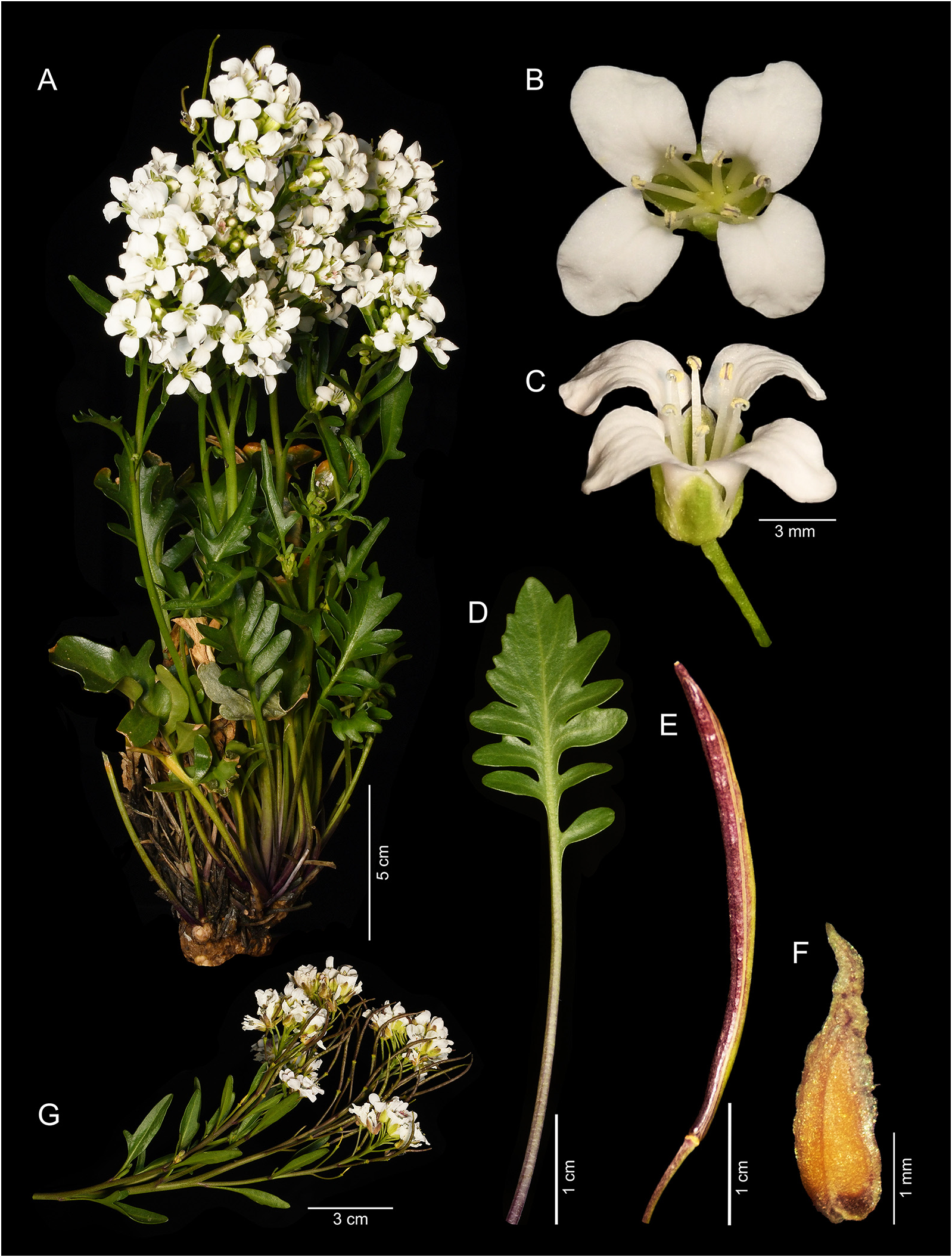
Christolea crassifolia
Christolea crassifolia Cambess.

Christolea crassifolia, a member of the Brassicaceae family, is a plant species native to regions including Afghanistan, Nepal, Pakistan, Qinghai, Tadzhikistan, Tibet, the West Himalaya, and Xinjiang. It was first described in 1841 by Cambess.
Description
Christolea crassifolia belongs to the Brassicaceae family, commonly known as the mustard family. This species is distributed across several regions in Central and South Asia, including Afghanistan, Nepal, Pakistan, Qinghai, Tadzhikistan, Tibet, the West Himalaya, and Xinjiang. The species was first formally described in 1841 by the botanist Cambess. As part of the genus Christolea, it shares characteristics typical of the Brassicaceae family, such as the presence of four-petaled flowers and a distinct fruit type known as a silique. Its native range suggests it is adapted to a variety of high-altitude and temperate environments.
Distribution
Afghanistan · Nepal · Pakistan · Qinghai · Tadzhikistan · Tibet · West Himalaya · Xinjiang
Synonyms
Christolea afghanicaChristolea incisaChristolea pamiricaErmania crassifoliaErmania pamiricaChristolea crassifolia var. pamiricaKoelzia afghanicaParrya ramosissima