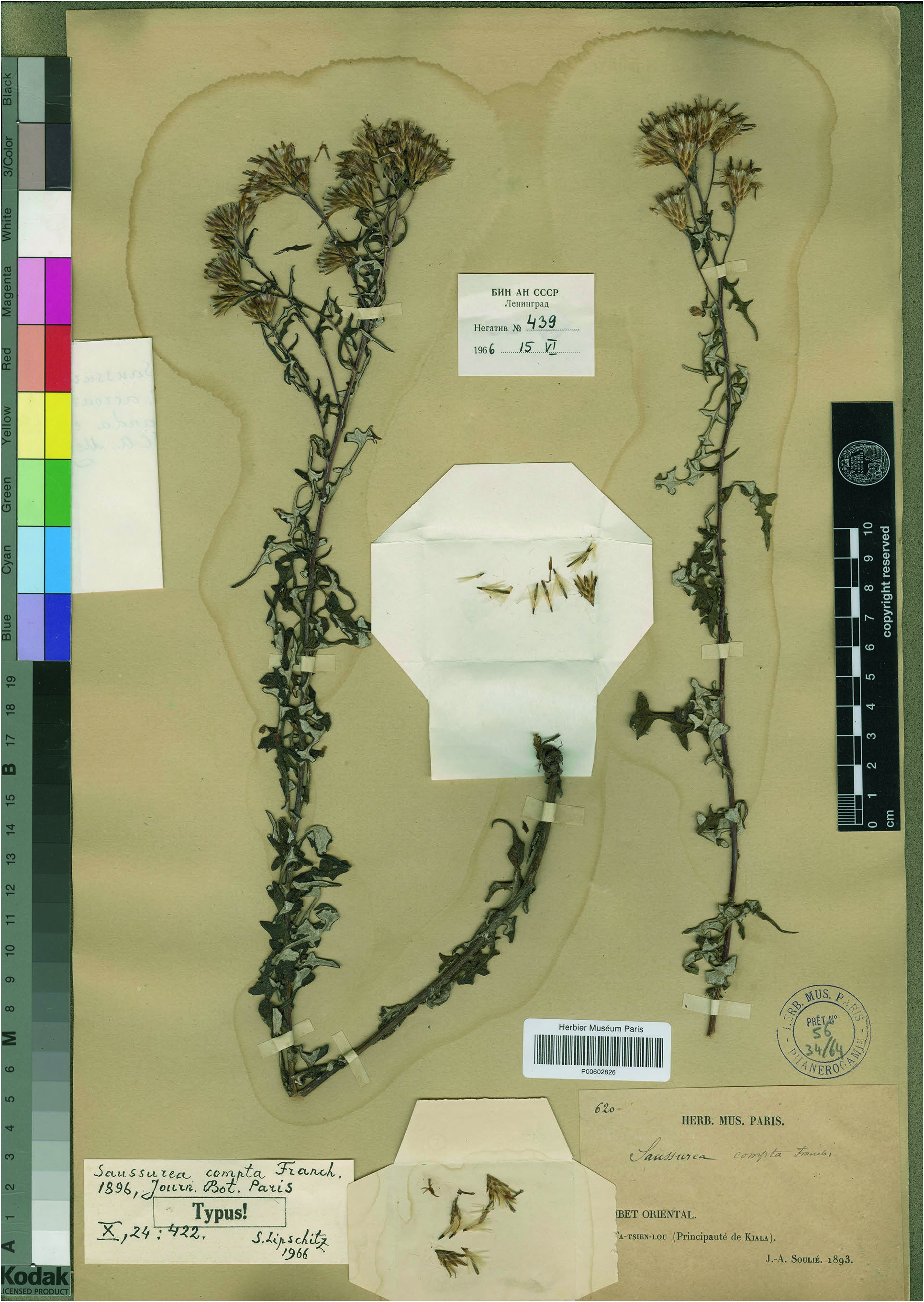
Catananche lutea
Catananche lutea L.

Catananche lutea is an annual herb in the Asteraceae family, known for its woolly texture and unique reproductive strategy. It is native to the Mediterranean region and is characterized by a basal rosette of leaves and erect, unbranched or weakly branched flowering stems. The plant produces yellow ligulate flowers between April and June, with a distinctive involucre that extends beyond the petals. It exhibits amphicarpy, producing multiple seed types with varying dispersal and germination behaviors.
Description
Catananche lutea is an annual herb reaching 8–40 cm in height, with a woolly surface. The plant features a basal rosette of many linear, narrowly ovate, or linear-elliptic leaves, 3–27 cm long and 0.7–2 cm wide. The flowering stems are erect, pilose, and weakly branched or unbranched. The synflorescence includes several heads at the base of the stem and 1 to several terminal heads on long peduncles, which can reach up to 20 cm in length. The involucre is cylindrical to bell-shaped, 15–30 mm long, with ovate outer bracts and narrowly ovate inner bracts. The corolla is ligulate, 1.3–1.5 mm long, and yellow. Achenes are homomorphic or dimorphic, 3–4 mm long, pilose, and ribbed, with a pappus up to 8 mm long and aristate or acute scales. The plant is notable for its amphicarpy, producing both larger, soil-retained seeds and smaller, wind-dispersed seeds.
Habitat
Catananche lutea is native to the Mediterranean region, where it thrives in dry, open habitats such as rocky slopes, disturbed soils, and coastal areas. It is commonly found in countries like Spain, France, Italy, Greece, Turkey, and North African nations. The plant is well adapted to arid and semi-arid climates and is often seen in disturbed or open ground, especially in regions with a Mediterranean-type climate characterized by hot, dry summers and mild, wet winters.
Cultivation
Catananche lutea is relatively easy to cultivate in well-drained soils and full sun. It prefers dry to moderately moist conditions and is suited to rock gardens, wildflower meadows, and xeriscapes. The plant can be propagated from seed, which should be sown in early spring. Due to its amphicarpic nature, the plant may self-seed readily in suitable conditions. It is drought-tolerant and requires minimal maintenance once established. However, it is best suited for gardeners in temperate to warm climates and may not survive in regions with harsh winters unless protected.
Uses
Catananche lutea is primarily of ecological interest due to its unique reproductive strategy of amphicarpy, which allows it to produce seeds with different dispersal and germination patterns. This adaptation enhances its survival in variable environments. While not commonly cultivated for ornamental purposes, it can be used in native plant gardens and as a component of wildflower mixes. The plant has no significant economic or medicinal uses but is occasionally referred to as 'yellow succory' in English sources. Its yellow flowers and woolly texture make it a distinctive addition to Mediterranean-style gardens.
Distribution
Israel · Jordan · Tunisia · Sardegna · Spain · France · East Aegean Is. · Macedonia · Sicilia · Lebanon · Algeria · Libya · Malta · Italy · Cyprus · Syria · Turkey-in-Europe · Turkey · Portugal · Kriti · Morocco · Greece · Belgium · The Netherlands · Great Britain · FR · Lebanon-Syria · Palestine
Synonyms
Piptocephalum carpholepisCatananche lutea subsp. luteaCatananche lutea subsp. carpholepis