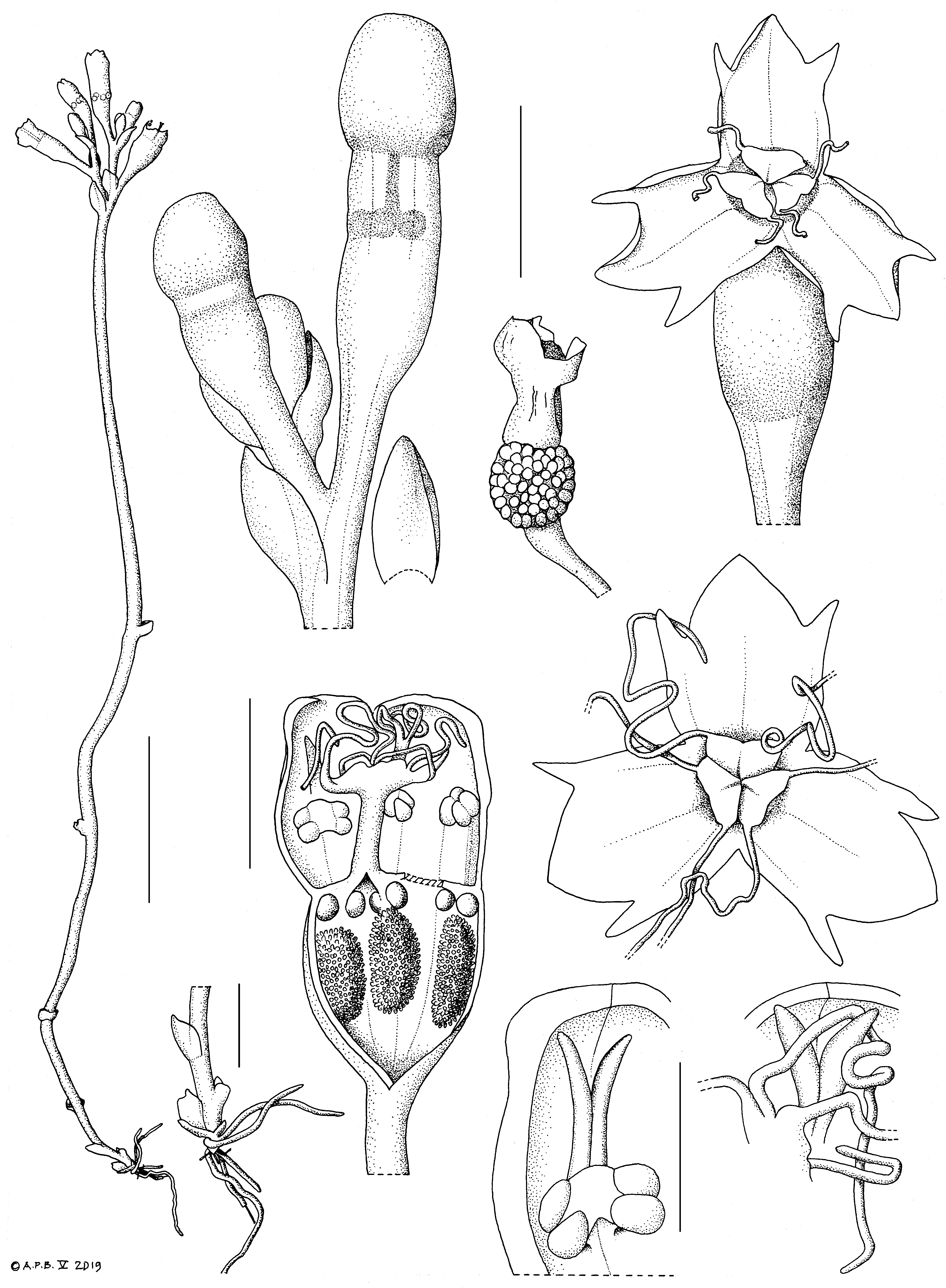
Burmannia itoana
Burmannia itoana Makino

Burmannia itoana is a non-photosynthetic, perennial herb in the Burmanniaceae family, found in subtropical and tropical wet evergreen forests across several regions in East and Southeast Asia. It is characterized by its violet-blue coloration, with a branching stem, scale-like leaves, and a terminal inflorescence of up to three flowers. The species is found in Vietnam, where it has been newly recorded, and is locally common in certain areas.
Description
Burmannia itoana is a terrestrial herb with a violet-blue coloration, non-photosynthetic, and perennial. It has filiform roots attached at the stem base and a branching stem that is light violet-blue, 7–10 cm long. The leaves are scale-like, narrowly triangular, and light violet-blue. The inflorescence is a terminal botryoid with up to three flowers, including a terminal flower and one to two lateral flowers. The flowers are erect, actinomorphic, and bright violet-blue, with a cylindrical floral tube and fleshy, triangular outer tepal lobes. The species is found in subtropical and tropical wet evergreen forests at elevations of 300–1200 m, flowering and fruiting from April to December. It is rare in some areas, such as Ta Xua Nature Reserve, but locally common in others, like Song Thanh Nature Reserve.
Distribution
TW · China South-Central · China Southeast · Hainan · Japan · Nansei-shoto · Taiwan · Vietnam
Synonyms
Burmannia pingbienensisBurmannia takeoi