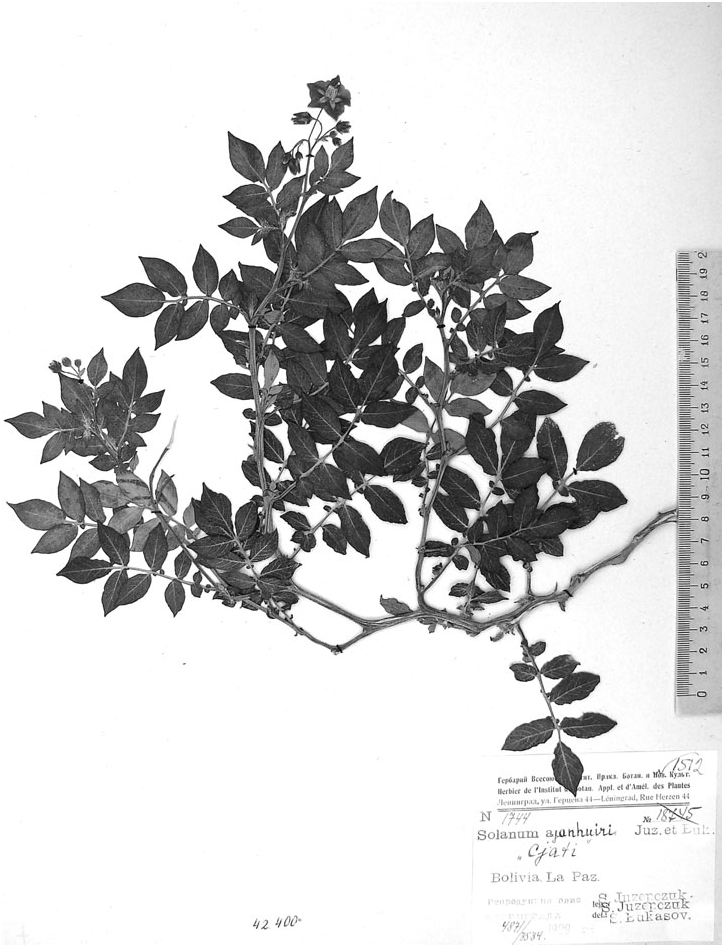
Brazilian potato-tree
Solanum wrightii Benth.

Solanum wrightii, commonly known as the Brazilian potato-tree, is a member of the Solanaceae family and is part of the Leptostemonum Clade within the genus Solanum. This species is notable for its spiny characteristics and is primarily found in the eastern slopes of the Andes in Bolivia. Although originally described from Hong Kong, it is not native to that region and is more commonly cultivated in tropical Asia as a shade and street tree. The plant is distinguished by its large flowers and fruits, as well as its broad, repand leaves. Despite its widespread use in cultivation, it does not appear to naturalize in the wild and is rarely found outside of human-planted settings.
Description
Solanum wrightii is a spiny shrub or small tree with large, showy flowers and fruits. The leaves are typically large and repand in shape, contributing to the plant's ornamental appeal. The species is part of the Crinitum clade, a group characterized by its robust growth and large floral displays. The plant's spiny nature suggests a defensive adaptation, which is common among many species in the Solanum genus. The species was first formally described in 1861 by Bentham, based on material collected in Hong Kong, though its true origin lies in the Andean region of Bolivia. The holotype material for this species has been designated as the Kew duplicate of Wright 849, ensuring a clear taxonomic reference for future studies.
Habitat
Solanum wrightii is primarily native to the Andean slopes of Bolivia, where it grows in tropical and subtropical environments. However, it is not found in the wild in Hong Kong, despite being originally described from there. The plant is widely cultivated in tropical Asia for ornamental and utilitarian purposes, such as street and shade tree planting, and as living fencing. It is typically found in human-modified landscapes and does not appear to establish itself naturally in the wild outside of cultivation. The species thrives in warm, humid climates and is often planted in urban and suburban areas where its large size and ornamental features are appreciated.
Cultivation
Solanum wrightii is cultivated in tropical regions, particularly in Asia, for its ornamental value and utility as a shade or street tree. It is often used in landscaping for its large, attractive leaves and flowers, as well as for its spiny structure, which can serve as a natural deterrent. The plant is relatively easy to grow in warm, humid climates and requires well-drained soil. It is not known to naturalize in the wild and is rarely collected outside of cultivated settings. The species is propagated through seeds or cuttings and is well-suited for use in urban environments where its size and form can provide both shade and aesthetic appeal. However, due to its spiny nature, care should be taken when planting it in areas with high foot traffic.
Uses
Solanum wrightii is primarily used as an ornamental and functional tree in tropical regions, particularly in urban and suburban landscapes. It is commonly planted as a shade tree, street tree, and for living fencing due to its large size and spiny structure, which can act as a deterrent. In tropical Asia, it is widely appreciated for its aesthetic qualities, including its large leaves and showy flowers. The species is not typically used for food or medicinal purposes, and there is no evidence of it being naturalized in the wild outside of cultivation. Its utility in landscaping and urban planning makes it a valuable addition to tropical gardens and public spaces, though its spiny nature requires careful placement to avoid injury.
Other common names
Brazilian potato-treepotato-tree
Distribution
Distrito Regional de Manejo Integrado (DRMI) Laguna de Sonso, municipio de Guadalajara de Buga, Valle del Cauca, Colombia · CD · RW · IN · ST · CO · Global · the Democratic Republic of the Congo · Bolivia · Cameroon · China Southeast · Congo · Costa Rica · Gabon · Ghana · Jawa · Kenya · Malawi · Myanmar · Nicaragua · Nigeria · Sierra Leone · Tanzania · Uganda · Venezuela · Zambia · Zaïre · Zimbabwe · Guinée forestière
Synonyms
Solanum macranthumSolanum setosicalyx