Brazilian Guava
Psidium guineense Sw.

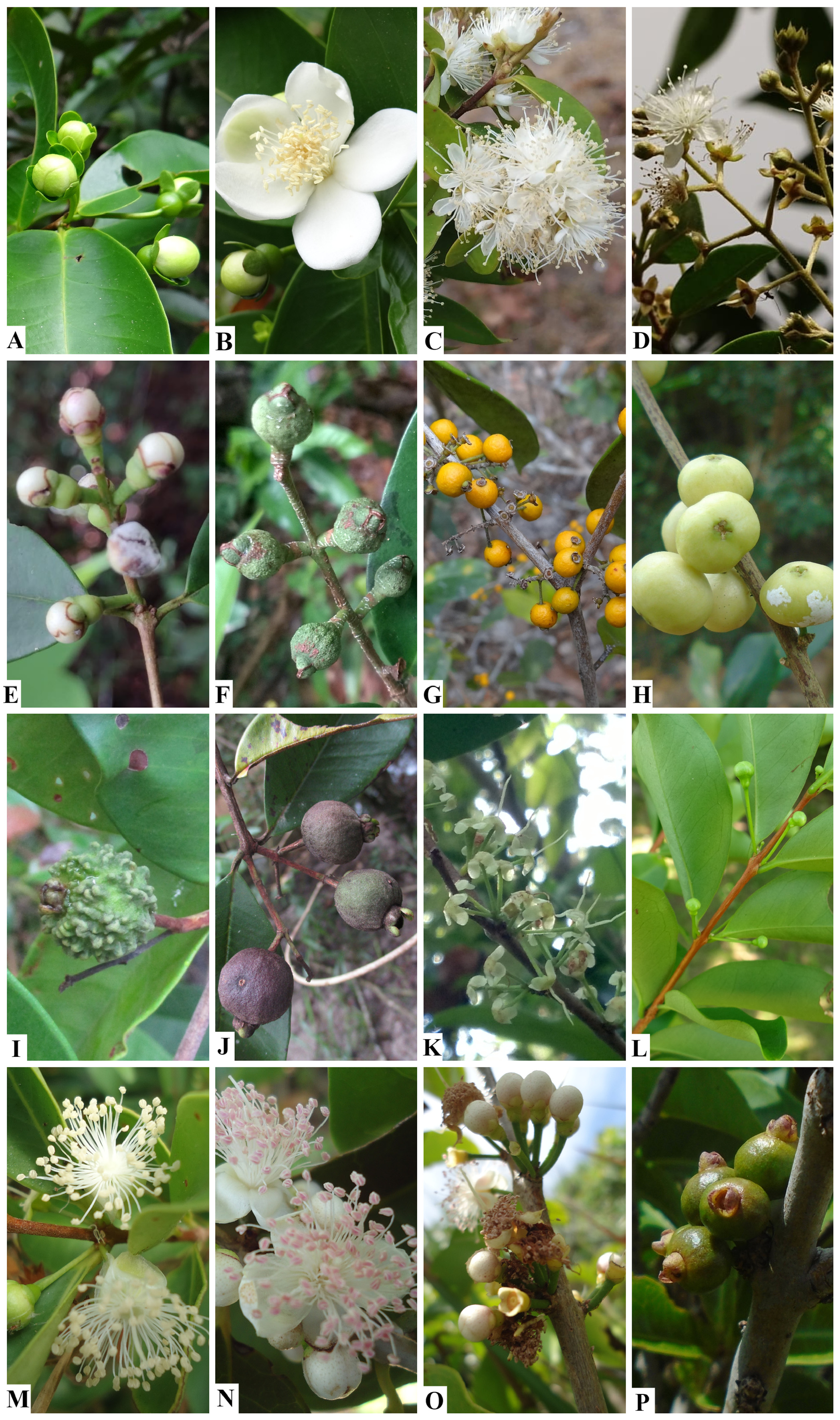
Psidium guineense, commonly known as Brazilian Guava, is a shrub species in the Myrtaceae family, native to a wide range in South America, including regions in Colombia, Brazil, and other neighboring countries. It is characterized by its elliptic to oblong leaves, solitary or dichasial inflorescences, and fused calyx lobes. This species is widely distributed and cultivated, often found in lowland and forested areas.
Description
Psidium guineense is a shrub that typically grows to a height of 1–3 meters. Its twigs are sparsely or densely covered with reddish-brown pubescence. The leaves have short petioles and elliptic to oblong blades, measuring 4–13.5 cm in length and 1.8–6.8 cm in width. The leaves are densely or sparsely pubescent, with a discolorous, chartaceous texture and a cuneate or rounded base. The apex is acute, mucronate, or obtuse. The inflorescence is axillary and may consist of a single flower or a dichasium. The calyx lobes are completely fused and open through irregular tearing, while the ovary is 3–5 locular. The immature fruit is globose, smooth, and marked with glands.
Habitat
This species is commonly found in forest fragments and lowland areas, particularly in the Atlantic Forest regions of northeastern Brazil. It thrives in a variety of habitats, including those in the Amazonian Maranhão and other parts of South America, often below 2800 meters in elevation. It is also present in enclaves with subxerophytic conditions, as well as in protected natural areas such as the Sierra de la Macarena National Park and the Los Estoraques Natural Area.
Cultivation
Psidium guineense is widely cultivated for its fruit and is found in both wild and managed settings. It is adaptable to various environmental conditions and is often grown in home gardens and commercial plantations. The plant is relatively hardy and can be propagated through seeds or cuttings. Its growth is supported in well-drained soils and it benefits from moderate to high humidity.
Uses
The primary use of Psidium guineense is for its edible fruit, which is consumed fresh or processed into juices, jams, and other food products. The fruit is known for its high nutritional value, including vitamins and antioxidants. Additionally, the plant has potential in agroforestry systems and ecological restoration due to its adaptability and ability to thrive in disturbed environments.
Other common names
Brazilian GuavaGuinea guava
Distribution
Antioquia, Cauca, Cesar, Chocó, Huila, La Guajira, Magdalena, Meta, Nariño, Norte de Santander, Risaralda, Valle del Cauca · BR · Subregiones: Cordillera occidental, Cordillera central, Enclaves subxerofíticos · CO · Tuluá | Bolívar | Guayatá | Somondoco | Almeida | Chivor · Área Natural Única Los Estoraques | Parque Nacional Natural Sierra de la Macarena · ZA · SC · CU · CD · Zona oriental · Bucaramanga | Floridablanca | Girón | Páramo | Piedecuesta | Suaita | Tona · Se encuentra distribuida en todo el país por debajo de 2800 m de altitud · Madeira · Boyacá | Garagoa · TZ · AO · MG · KE · AU · PF · East Usambara · Paz de Río | Socha · Amazonas, Antioquia, Boyacá, Caldas, Caquetá, Casanare, Cauca, Cesar, Cundinamarca, La Guajira, Huila, Magdalena, Meta, Nariño, Norte de Santander, Quindío, Risaralda, Santander, Valle, Vaupés, Vichada · Amazonia colombiana: sur del departamento del Vichada; el suroriente del Meta; todo el territorio de los departamentos de Amazonas, Caquetá, Guainía, Guaviare, Putumayo y Vaupés; la Bota Caucana; y las vertientes amazónicas de Nariño (la parte alta de los · Global · the Democratic Republic of the Congo · SV · HN · GT
Synonyms
Mosiera guineensisMyrtus guineensisMyrtus hauthaliiPsidium albidumPsidium aracaPsidium benthamianumPsidium costa-ricensePsidium dichotomumPsidium hasslerianumPsidium hiansPsidium jollyanumPsidium laurifoliumPsidium lehmanniiPsidium minusPsidium mollePsidium monticolaPsidium multiflorumPsidium ooideumPsidium ooideum var. longipedunculatumPsidium polycarponPsidium rotundifoliumPsidium rufinervumPsidium schiedeanumPsidium schippiiPsidium sericiflorumPsidium ypanemenseCampomanesia multifloraCampomanesia tomentosaPsidium hians var. cuneatumPsidium hians var. truncatum