blackrodwood
Eugenia biflora (L.) DC.

Eugenia biflora, a member of the Myrtaceae family, is a tree or shrub species that occurs in a wide range of habitats across Central and South America. Known as blackrodwood, it is commonly found in tropical forest ecosystems and is characterized by its pubescent leaves and fruits. The species is recognized for its ecological adaptability and is assessed as Least Concern (LC) by conservation authorities.
Description
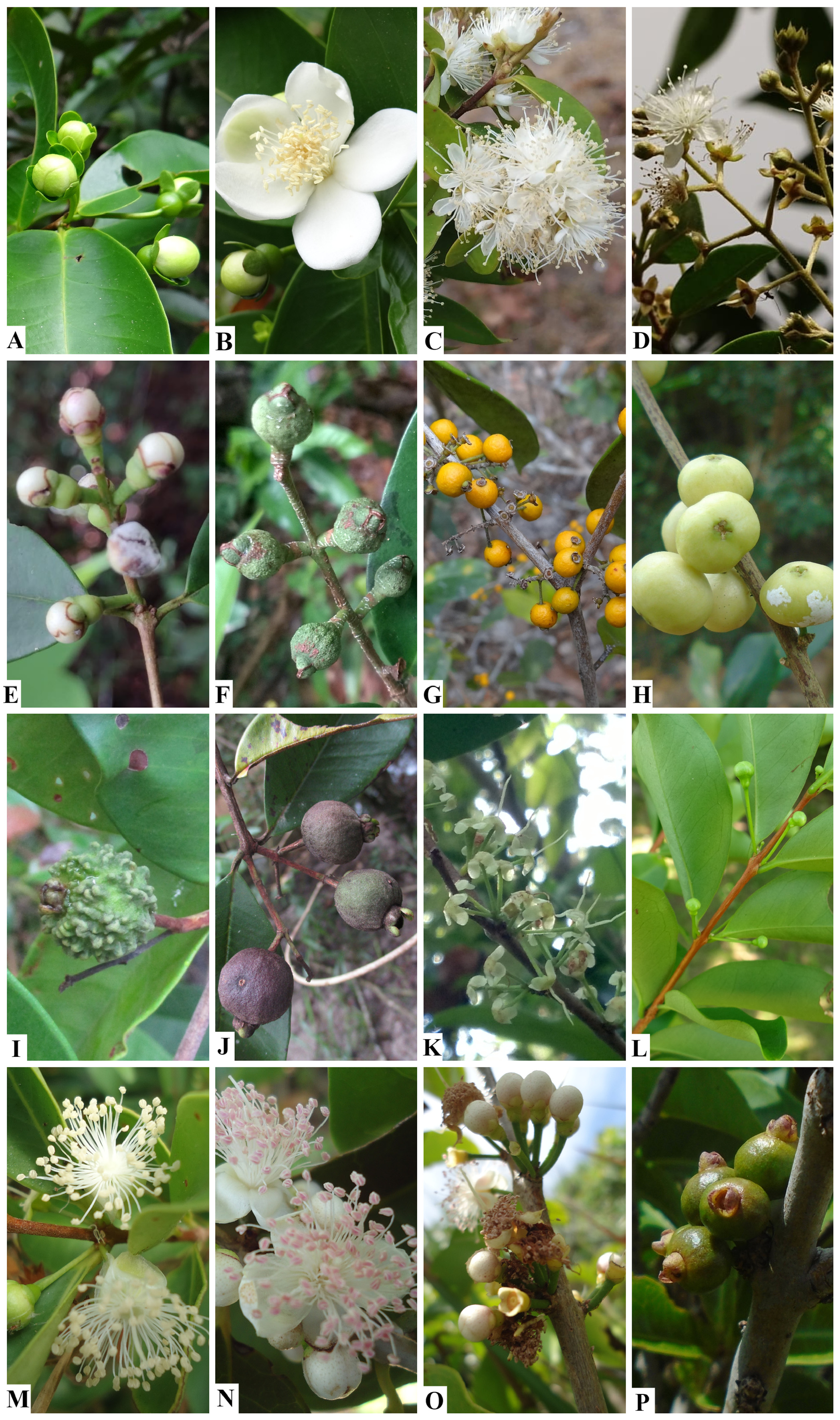
Eugenia biflora is a tree or shrub that typically grows to a height of 1–4 meters. Its twigs are densely covered with a whitish indumentum. The leaves are elliptic, lanceolate, or ovate, measuring 3–7.8 cm in length and 1.2–4.1 cm in width, with a pubescent or densely pubescent surface and a whitish coating. The leaf base is rounded, cuneate, or attenuate, and the apex is acuminate, long acuminate, or apiculate. The midvein is impressed on the upper surface, and the lateral veins are visible on the lower surface, with 12 to 20 pairs. The inflorescences are axillary racemes with a pubescent axis and persistent bracts. The flowers have four free, ovate to deltate calyx lobes, and the ovary is two-locular. The immature fruits are subglobose or globose, measuring 0.6–0.8 cm in diameter, and are densely pubescent with a smooth surface.
Habitat
Eugenia biflora is native to the Humid Tropical Forest domain, where it thrives in areas with no significant habitat loss or invasion by exotic species. It is found in conservation areas such as the Reserva de la Biosfera La Sepultura and the Reserva de la Biosfera Montes Azules in Chiapas, Mexico. The species is distributed across Southeast Mexico, through Central America, and into South America, including regions in Colombia, Brazil, and Bolivia. It is also present in the Antilles. The plant is commonly found in forest fragments and is adapted to a variety of tropical environments.
Cultivation
Eugenia biflora is a relatively hardy species that can be cultivated in tropical and subtropical climates. It prefers well-drained soils and partial to full sunlight. The plant is not commonly cultivated for commercial purposes but is sometimes grown in botanical gardens and conservation areas. Its ability to thrive in a range of tropical forest conditions makes it suitable for use in ecological restoration projects. Propagation can be achieved through seeds or cuttings, and the plant is generally resistant to pests and diseases in its natural habitat.
Uses
Eugenia biflora is primarily of ecological and conservation interest rather than economic use. It plays a role in maintaining biodiversity in tropical forest ecosystems and is often found in protected areas. The species is not widely utilized for timber, food, or medicinal purposes. However, its presence in conservation reserves highlights its importance in preserving native flora and supporting local ecosystems. The plant is also of interest to botanists and researchers studying the Myrtaceae family and tropical forest dynamics.
Other common names
blackrodwood
Distribution
Complejo Humedales Hato Corozal · Antioquia, Caquetá, Chocó, Cundinamarca, Huila, Santander, Valle del Cauca, Vaupés, Vichada · BR · Subregiones: Cordillera occidental, Cordillera central, Enclaves subxerofíticos · CO · Tuluá | Bolívar · Parque Nacional Natural El Tuparro · Distrito Regional de Manejo Integrado (DRMI) Laguna de Sonso, municipio de Guadalajara de Buga, Valle del Cauca, Colombia · Cimitarra | El Playón | Lebrija | Matanza | Pinchote | Puerto Wilches | Rionegro | Sabana de Torres · Antioquia, Caldas, Cesar, Chocó, Cundinamarca, La Guajira, Huila, Meta, Norte de Santander, Risaralda, Santander, Tolima, Valle, Vichada · Global · Jardín Botánico de Bogotá · Parque Nacional Natural Serranía de Chiribiquete (PNNSCh) · Belize · Bolivia · Brazil Northeast · Brazil North · Brazil West-Central · Cayman Is. · Colombia · Costa Rica · Dominican Republic · Ecuador · El Salvador · French Guiana · Guatemala · Guyana · Haiti · Honduras · Jamaica
Synonyms
Myrcia erythroxylon var. virescensMyrcia miniMyrcia schomburgkianaMyrtus berteroanaMyrtus bifloraMyrtus lanceaMyrtus miniMyrtus pallensMyrtus virgultosaEugenia biflora var. lanceaEugenia biflora var. ludibundaEugenia biflora var. miniEugenia biflora var. pallensEugenia biflora var. virgultosaEugenia freireana var. angustifoliaEugenia freireana var. latifoliaEugenia hoffmannseggii var. grandifoliaEugenia hoffmannseggii var. parvifoliaEugenia meyeriana var. depauperataEugenia meyeriana var. divesEugenia xylopifolia var. brevipesMyrcia splendens var. miniMyrtus biflora var. salicifoliaMyrtus biflora f. subsericeaMyrtus biflora var. yapacaniCaryophyllus fruticosusEugenia biflora var. hoffmannseggiiEugenia biflora var. myriostigmaEugenia jamaicanaEugenia mini var. microcarpos