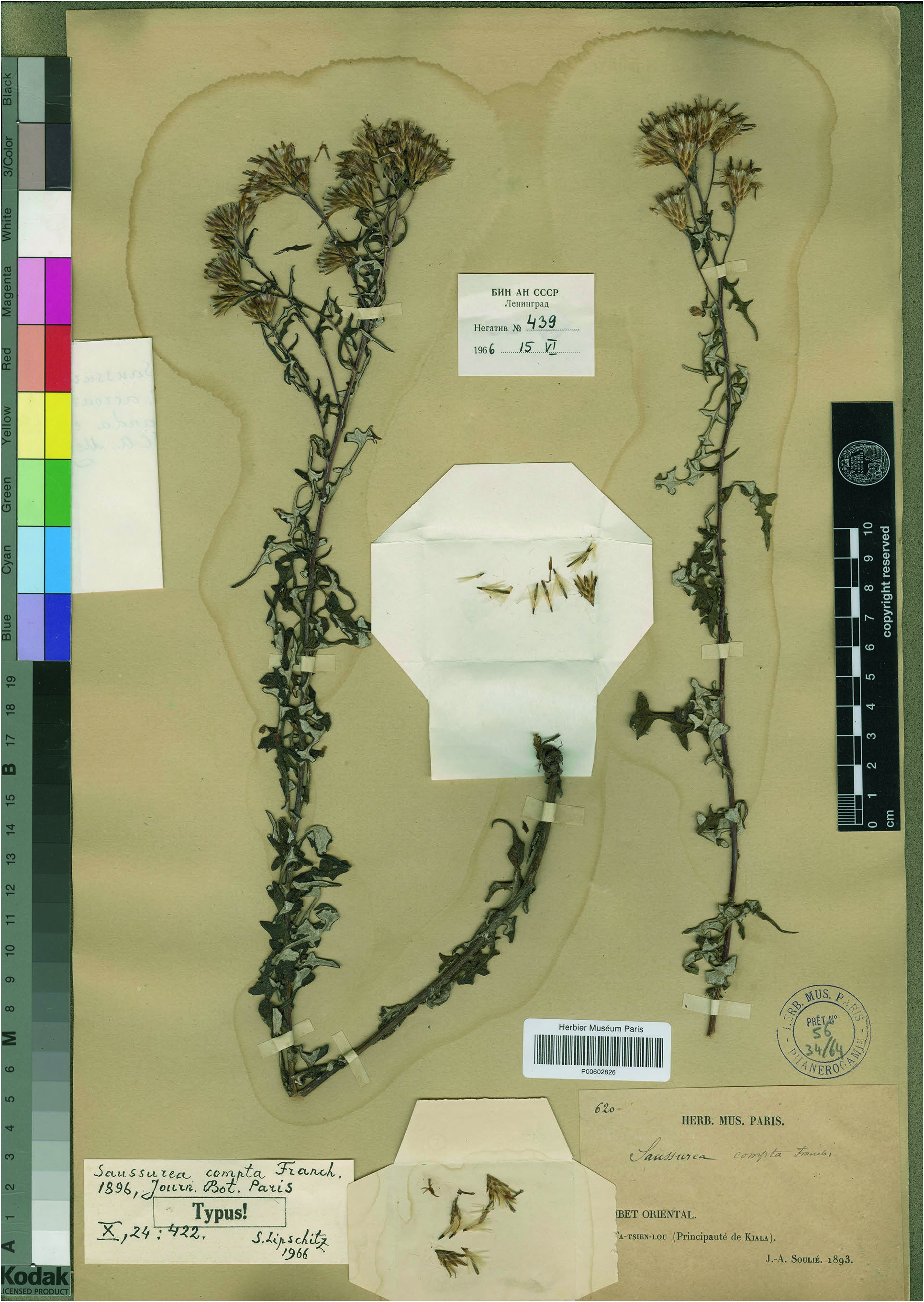
Artemisia rupestris
Artemisia rupestris L.

Artemisia rupestris L., a perennial herb in the Asteraceae family, is distributed across regions including SE, NO, Afghanistan, Altay, Baltic States, and parts of Russia and Central Asia. It typically grows 20–50 cm tall, is woody at the base, and has arachnoid-pubescent or glabrescent stems. The plant flowers from July to August and fruits from August to October. Leaves are pinnatisect, with linear or lanceolate segments. Synflorescence is spike-like or raceme-like, with nodding capitula and bisexual disk florets. Achenes are oblong or oblong-ovoid.
Description
Artemisia rupestris is a perennial, caespitose herb, 20–50 cm tall, with stems that are brown or dark brown and may be branched. Basal leaves are ovate-oblong or oblong, 3–5 cm long, with 1- or 2-pinnatisect segments. Middle stem leaves are ovate-elliptic or oblong, also pinnatisect, with linear or linear-lanceolate lobules. Uppermost leaves and bracts are 1-pinnatisect. The synflorescence is a spike-like or raceme-like panicle, with hemispheric or subglobose capitula. Marginal female florets are 8–16, and disk florets are 30–70, bisexual. Achenes are oblong or oblong-ovoid, often with a minute apical crown. Distribution in Ruoqiang, Xinjiang, China, is uncertain due to lack of specimens.
Distribution
SE · NO · Afghanistan · Altay · Baltic States · Buryatiya · Chita · East European Russia · Germany · Irkutsk · Kazakhstan · Kirgizstan · Krasnoyarsk · Mongolia · North European Russi · Sweden · Tadzhikistan · Tuva · Uzbekistan · West Siberia · Xinjiang · Yakutskiya
Synonyms
Absinthium rupestreAbsinthium rupestre var. rupestreAbsinthium rupestreArtemisia rupestris subsp. woodiiArtemisia rupestris subsp. rupestrisAbsinthium viridiflorum var. rupestreAbsinthium viridifolium var. rupestre