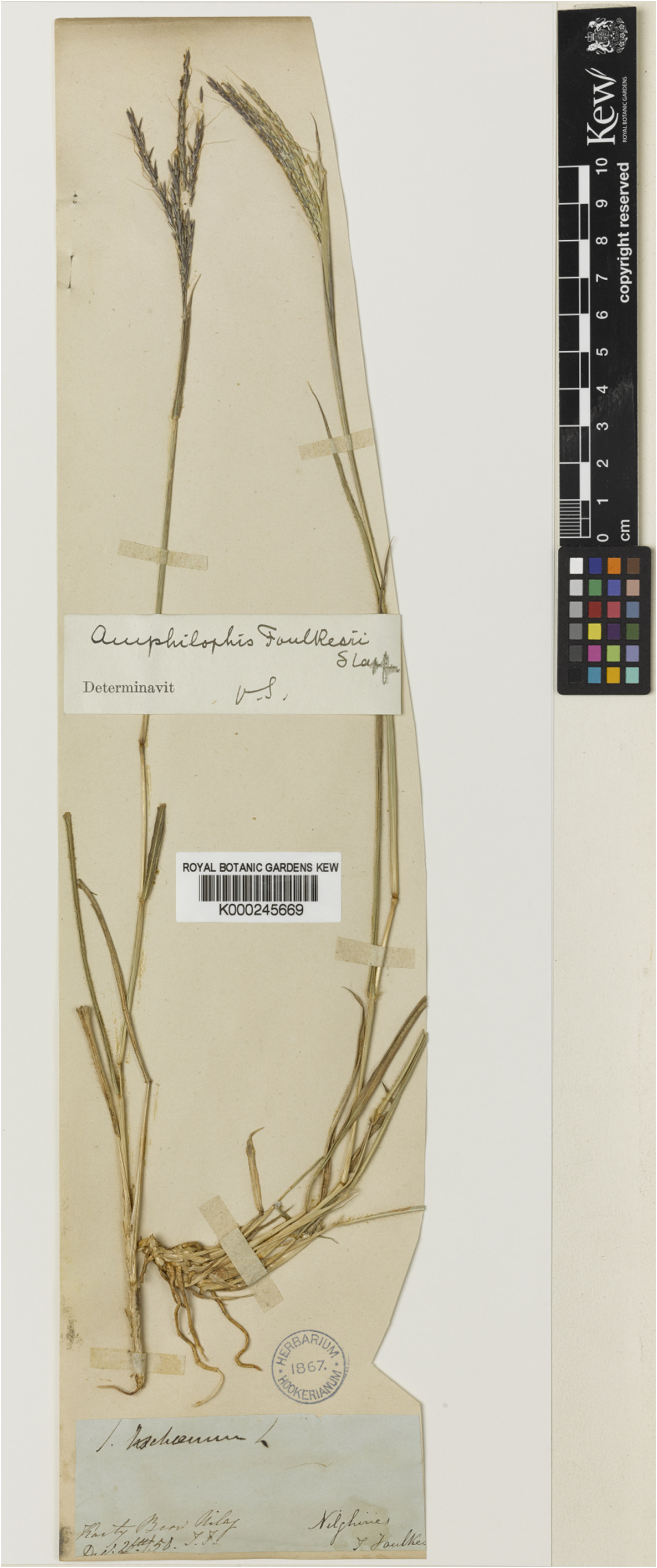
Angleton bluestem
Dichanthium aristatum (Poir.) C.E.Hubb.

Dichanthium aristatum, commonly known as Angleton bluestem, is a grass species in the Poaceae family. It is widely distributed across multiple continents and is primarily used as forage for livestock due to its adaptability and nutritional value.
Description
Dichanthium aristatum is a perennial grass characterized by its robust growth and ability to thrive in a variety of environmental conditions. It was originally described as Andropogon aristatus by Poiret in 1811, based on specimens collected from the island of France (now Ile de France). The type specimens, housed at the National Museum of Natural History in France, include three sheets from the Commerson collection. One of these, P 03459113, has been designated as the lectotype due to its alignment with the original description and the presence of both floral and vegetative structures. The grass features a tufted growth habit, with slender, blue-green leaves and a distinctive inflorescence of short, spikelike branches. Its adaptability to different soil types and climatic conditions contributes to its widespread use in agricultural settings.
Habitat
Dichanthium aristatum is found in a range of habitats, including grasslands, pastures, and disturbed areas. It is native to tropical and subtropical regions and has been introduced to many other parts of the world, including the United States, where it is often cultivated for forage. It thrives in full sun and can tolerate moderate drought once established, although it prefers well-drained soils. It is commonly found in regions with warm to hot summers and mild winters.
Cultivation
Angleton bluestem is cultivated for its use as a forage grass in pastures and rangelands. It is typically established through seed sowing and benefits from good soil preparation and adequate moisture during the germination phase. The grass is relatively easy to grow and can be managed with regular mowing or grazing. It is often used in mixtures with other forage species to enhance productivity and provide a more balanced diet for livestock. It is also suitable for erosion control due to its extensive root system.
Uses
The primary use of Dichanthium aristatum is as a forage crop for livestock, including cattle and sheep. It is valued for its palatability and nutritional content, making it an important component of grazing systems in many tropical and subtropical regions. In addition to forage production, it can be used for soil stabilization and erosion control, particularly in areas with degraded or marginal soils. Its ability to grow in a wide range of conditions makes it a versatile species for agricultural and environmental applications.
Other common names
Angleton bluestemAngleton grassawned dichanthiumbluestem
Distribution
TW · ZA · CU · MX · Socorro · ZW · GY · PG · ZM · AU · TL · Antioquia, Cauca, Córdoba, Cundinamarca, Huila, Nariño, Norte de Santander, Tolima, Valle · CR · Bogotá · MZ · Hawaii · conterminous 48 United States · Argentina Northeast · Ascension · Caroline Is. · China South-Central · Colombia · Costa Rica · Cuba · Dominican Republic · Ecuador · Fiji · Florida · Free State · Guyana
Synonyms
Andropogon caricosus subsp. mollicomusAndropogon caricosus var. mollicomusAndropogon incurvatusAndropogon koenigiiAndropogon mollicomusAndropogon pubescensDichanthium caricosum var. mollicomumDiplasanthum lanosumLepeocercis digitataLepeocercis mollicomaLepeocercis mollissimaAndropogon aristatusAndropogon caricosus var. glabriorAndropogon caricosus var. heteropogonoidesDichanthium aristatum var. heteropogonoides