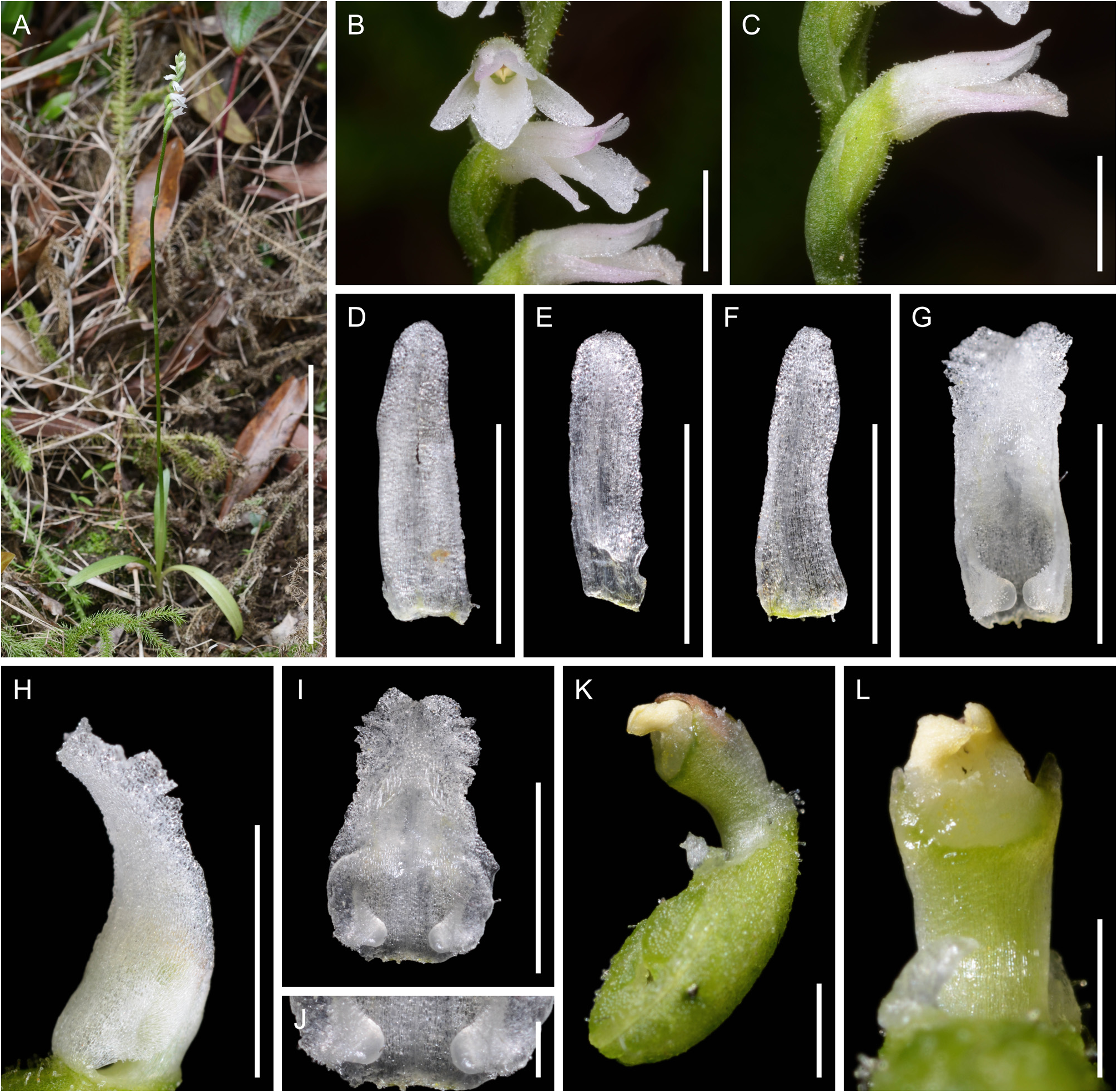
Spiranthes romanzoffiana, commonly known as American Lady's Tresses, is a species of orchid native to North America, Ireland, and Great Britain. It was first described in 1828 by the German naturalist Adelbert von Chamisso, who named it in honor of Count Nikolay Rumyantsev, a Russian statesman and patron of the Romanzov expedition. This orchid is characterized by its striking spiral arrangement of small, white to green-tinged flowers, which bloom in mid- to late summer. The plant is relatively small, with a stem height of 12 to 25 cm, and thrives in moist, peaty habitats such as lake shores and damp meadows. It is a perennial herb with a unique floral structure and is often found in a wide range of northern and subarctic regions of North America.
Description
Spiranthes romanzoffiana is a delicate, perennial herb with a slender, cylindrical root system and a single, upright stem that reaches 12 to 25 cm in height. The stem is sparsely glandular-puberulent, especially in the upper portion. The leaves are both basal and cauline, linear-lanceolate to narrowly oblong, and suberect. The lower leaves are typically 7 to 12 cm long and 5 to 13 mm wide, while the upper cauline leaves are smaller but not reduced to scales and remain present during flowering. The inflorescence is a dense spike measuring 3 to 6 cm in length and 2 cm in width, bearing 12 to 35 flowers arranged in three spiral rows. Each flower is approximately 12 mm long, with white petals tinged in green or cream, and all segments, including the labellum, are fused in the lower half. The labellum is slightly constricted below the sharply deflexed, crenulate apex. The plant flowers in mid- to late summer and has a diploid chromosome count of 2n = 60.
Habitat
Spiranthes romanzoffiana is typically found in damp, peaty soils and along the shores of lakes, where it thrives in cool, moist conditions. It prefers open, sunny habitats with high moisture levels and is often associated with wet meadows, bogs, and the edges of water bodies. The plant is adapted to northern and subarctic climates and is commonly found in regions with long, cold winters and short growing seasons. It is well-suited to the acidic, nutrient-poor soils typical of boreal and alpine ecosystems.
Cultivation
Cultivating Spiranthes romanzoffiana requires a careful balance of moisture and light. It thrives in cool, humid environments with consistently damp, peaty soil. The plant benefits from partial to full sun exposure and should be grown in a well-drained but moisture-retentive substrate. In cultivation, it is important to maintain high humidity levels and avoid periods of drought. The plant is not particularly demanding in terms of nutrients but should be provided with a slightly acidic to neutral pH. It is best suited for alpine or bog gardens and may require protection from intense heat or dry conditions in more temperate climates.
Uses
Spiranthes romanzoffiana is primarily valued for its ornamental beauty and ecological role in wetland and boreal habitats. It is not widely cultivated for commercial purposes but is appreciated by orchid enthusiasts and conservationists for its delicate, spiral-flowered inflorescence. The plant plays an important role in supporting local pollinators, particularly bees and other small insects, which are attracted to its nectar-rich flowers. In some regions, it is considered a symbol of the northern wilderness and is protected in nature reserves and botanical gardens to preserve its natural habitat and ensure its continued survival.
Other common names
American Lady'S TressesHooded Ladies' TressesHooded Ladies'-TressesHooded Lady'S TressesIrish Lady'S-Tresseshooded ladiestresses
Distribution
Labrador · Newfoundland · Alberta · British Columbia · Manitoba · New Brunswick · Nova Scotia · Northwest Territories · Nunavut · Ontario · Prince Edward Island · Quebec · Saskatchewan · Yukon · Saint Pierre and Miquelon · Vermont-US · NO · Global · Alaska · Aleutian Is. · Arizona · California · Colorado · Connecticut · Great Britain · Idaho · Illinois · Indiana · Iowa · Ireland
Synonyms
Ibidium romanzoffianumIbidium strictumNeottia gemmiparaOrchiastrum romanzoffianumSpiranthes gemmiparaSpiranthes paucifloraSpiranthes strictaTriorchos romanzoffianusTriorchis strictusIbidium romanzoffianum var. strictumSpiranthes romanzoffiana var. strictaGyrostachys gemmiparaGyrostachys romanzoffianaGyrostachys strictaSpiranthes romanzoffiana var. romanzoffianaTriorchis romanzoffianusSpiranthes romanzoffiana var. gemmipara